

HOWEVER, you are at fault if you luff him after the gust that'll see him legally overtake you when you had maintained your course !
If you even force a crash on him then you are seriously at fault and can even be disqualified from the event all together with possible wider future sanctions.
Wouter
Not exactly. You can luff the windward boat as long as you do so within 16.1 giving the boat room to keep clear. If the windward boat reaches the point where she can't head up anymore without flipping she always has the option to slow down and go behind.
Basicaly the leward boat can go head to wind and long as she does so slowly enough to give the windward boat the oportunity to luff the spinnaker and go behind (most people forget about this option in the heat of battle).
11 ON THE SAME TACK, OVERLAPPED
When boats are on the same tack and overlapped, a windward boat shall
keep clear of a leeward boat.
16 CHANGING COURSE
16.1 When a right-of-way boat changes course, she shall give the other
boat room to keep clear.
The only time the leward boat is limmited is when she has come from clear astern (within two of her hull lengths)into the leward position. Then she can luff but only to her proper course.
17 ON THE SAME TACK; PROPER COURSE
17.1 If a boat clear astern becomes overlapped within two of her hull lengths
to leeward of a boat on the same tack, she shall not sail above her proper
course while they remain overlapped within that distance, unless in
doing so she promptly sails astern of the other boat. This rule does not
apply if the overlap begins while the windward boat is required by rule
13 to keep clear.
Proper Course: A course a boat would sail to finish as soon as possible in the
absence of the other boats refe;rred to in the rule using the term. A boat has no
proper course before her starting signal.
Check your definitions guys!
Basic rule of sailing -
rule 11: When boats are on the same tack and overlapped, a windward boat shall keep clear of a leeward boat.
The operative words here are "keep clear" as defined:
Keep clear: One boat keeps clear of another if the other can sail her course with no need to take avoiding action and when the boats are overlapped on the same tack, if the leeward boat can change course in both directions without immediatly making contact with the windward boat.
My reading of the situation is as follows:
Any windward boat relying on Rule 16.1 in a protest should be in for dissapointment however if there is a collision, leeward boats might be in trouble under rule 14.
Tiger Mike
And that sir, is the most assholish attitude I could possibly encounter on the race course.
Rounding someone up into the wind on the start line, ok, big deal, but heading up someone so high that they HAVE to capsize in order to avoid contact is grounds for an assbeating. People can get hurt on a capsize, gear can break, and purposely causing one of these situations to occur goes beyond the scope of competitive sportsmanship, into the area known as a "dickhead maneuver".
My two cents.
So if someone would cause you to follow the rules you want to give him an "assbeating". Makes me want to race!!!! Just make sure when you open that can of whupass that its big enough. 
Clayton
Yeah, you are probably well within the rules to pull that one but it is also stupid. Firstly, since 99% of the time you aren't in the same division, you are slowing both yourself and somebody else down - how stupid is that???
Next - check out rule 22.2 - you might wind up with the dickhead of the month award!
Tiger Mike 
Do you guys think these rules discussions are really helpful? Or do they just confuse people with all the different interpretations, some of which are not even based upon the same scenario of events?
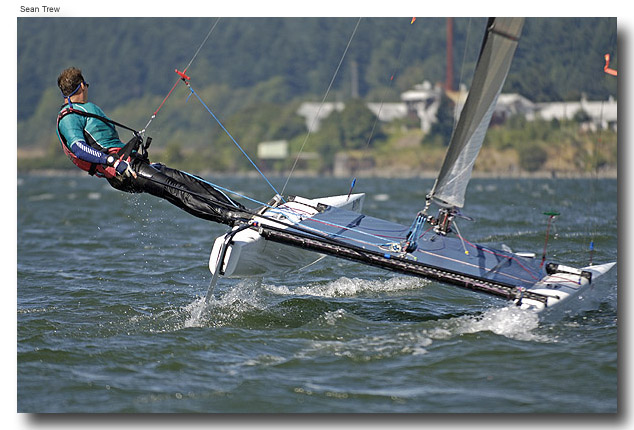
So there I was....I-20...charging to the gate...wife handling the spi sheets.....when all of a sudden....H-16 in our path! WE HAD NO RIGHTS!...so what did we do...??
ME: (YELLING) DUMP THE SHEETS
HER: DUMPING THE SHEETS
ME: SLAMMING THE HELM OVER...HEADING UP....
HER: YELLING...OH MY *&^% GOD
ME: OH *(&^^ MY GOD...HEADING UP
SPI: RUFFLING UMONGST THE JIB...
I-20...ROUNDING UP PERFECTLY...
HER: RE-TRIMMING AFTER OUR 360....
I-20: PASSING THE GATE AFTER THE 360....PASSING THE H-16 UPWIND WITH THE CREW YELLING...."WE ARE SO SORRY"...
and pouring us a beer after the regatta.....follow the rules..have fun...make freinds...and sail to the best you can be.....

Yes, very helpfull; This one thread has identified (and hopefully corrected) some glaring holes in a couple of peoples understanding of fairly basic rules. It has to be a good thing.

Hi All,
Nice post!
A word about ' us port layline' types.
It is wonderful thing that a Uni lays the top mark in 2 tacks.....[ which is why we are on port tack]
..when the I-20's,Tornadoes, P19MX's and N5.8's [ down here] do it in 3 [4,5,..] tacks....[ mostly, they are away back when I round, except for the I-20, which can go fast upwind]

.....the traffic at the top mark is the mono fleet that started before us. [ which is moving the best they can, ie, slooooooow, however, all rules still apply]
Last comment;
What age is considered ' old guy' ? 
[ I'm 53..
...6 time H 16{current} Champ Kiki Figueroa is in his 40's, at St. Thomas Rolex last month, his H-16(non-spin) beat a Spin Tornado{DPN},...imagine that..]
..go sailing,...have some fun!
regards,
Bruce
St. Croix
USVI
I-17
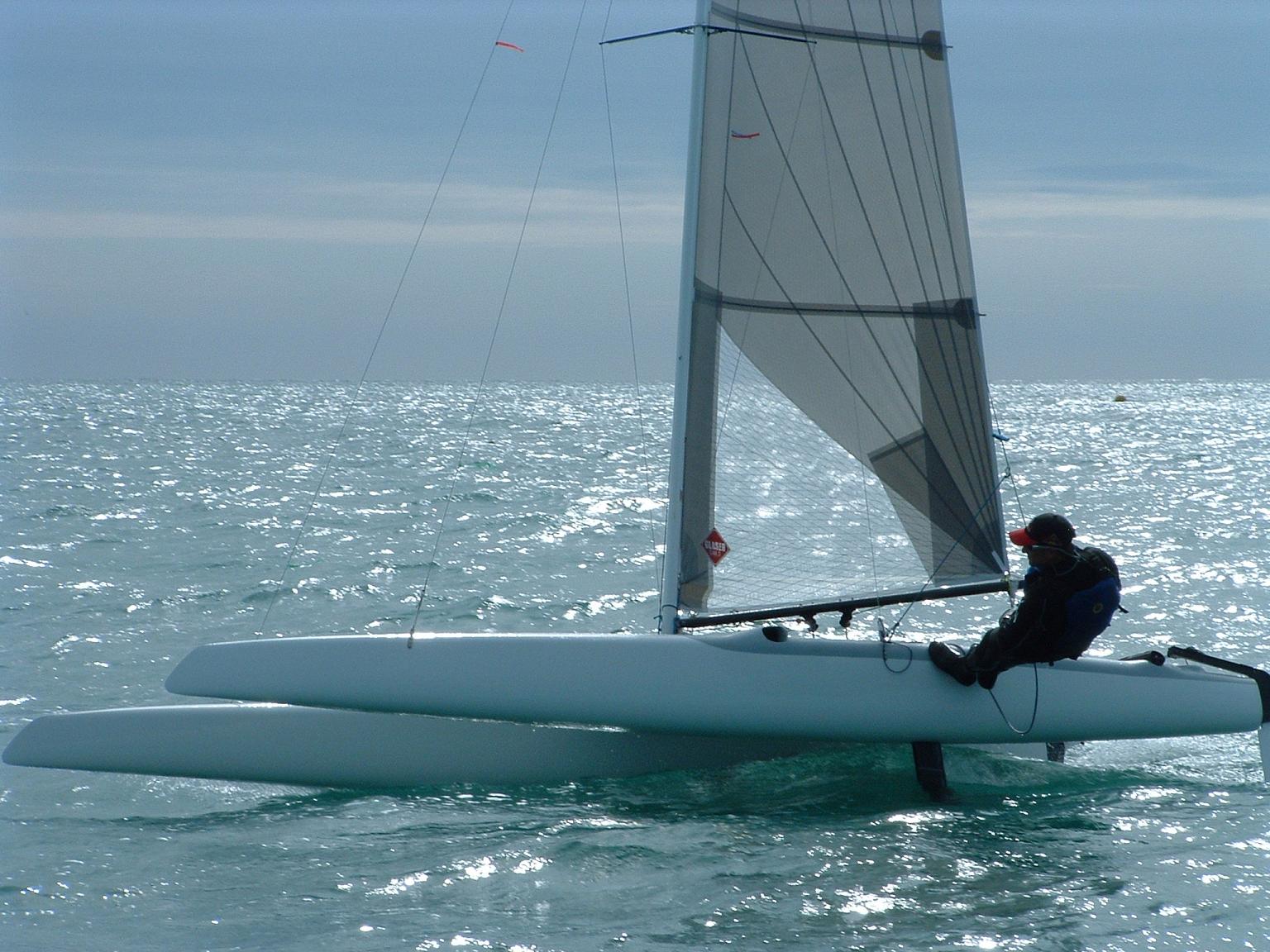
[ I'm 53..
...6 time H 16{current} Champ Kiki Figueroa is in his 40's, at St. Thomas Rolex last month, his H-16(non-spin) beat a Spin Tornado{DPN},...imagine that..]
The H-16 driver I referred to in my post was probably in his late 50's or 60's and had a young female crew. I speak of him in admiration because I (at the young age of 47) certainly hope to still be active like him when I am in my 50's and 60's (Gordon Isco is one of my heros!). I was bummed to see him discouraged by the incident. Like I said earlier, the I-20 could have easily headed up a few degrees if they had anticipated him earlier. Once more, I believe the I-20 driver probably realizes that he could have avoided the situation and he'll know what to do next time.
I'll make my point once more. If you are the faster boat and have the right of way, you have more control of the situation then the slower give way boat. Look ahead and try to communicate to the slower boat what you will do or what you want them to do especially if you see they are tyring to keep clear but cannot get out of your way fast enough.
Heads up sailing will not only keep you safe but will keep you sailing faster and smarter. Carlton Tucker always preached getting your head out of the boat and that advice is never more important than now when many sailors have all that sail area in front of the boat.
Sail fast, smart, and safe.
Bob Hodges
That's good advice, Bob, but it is not really consistent with the rules for a faster boat to give way to a slower boat even when the faster boat has right-of-way.
And I think that the rules that have been developed over many decades do not seem to take into consideration the problems encountered between boats of greatly different speed levels.
I think the rules in general have been developed in terms of one-design racing, and they also work for handicap racing for boats of very similar speeds.
But when you have a Wave sailing straight downwind with big, fast, spinnaker boats criss-crossing the course, or when you have Wave sailing upwind with big, fast spinnaker boats crossing them, the Wave is like a deer in the headlights. It really cannot do much to get out of the way, any more than, as I said earlier in this thread, a tractor on a freeway. You just have to pray that the traffic sees you and flows around you. It is very intimidating to people like me, and I just drop out of the regatta.
Maybe the fast boats will experience this intimidation factor if they are on the course with hydrofoil boats that are going 35 knots while the non-hydrofoil boats are going only 18 knots.
As I said, these problems can be resolved by courses that are properly set up to accommodate boats of greatly different speeds.
But that still does not address the rules issues when boats of drastically different speeds meet on the race course.
Maybe we should be required to have whistle signals or something, but can people on other boats actually hear whistles from another boat when they are screaming downwind or charging through waves upwind? Rick can't even hear a whistle if I blow it in our own living room, because he can't hear high-pitch sounds.

As I said, these problems can be resolved by courses that are properly set up to accommodate boats of greatly different speeds.
Mary,
Have you got some examples of how courses can be set to compensate for this?
One thing we have done is to set a shorter course for the slower boats by adding a different colored A mark downwind of the long course A mark.
This doesn't address boats with big speed differences meeting at C mark. That could be resolved with another C mark for the short course (but we ony have 3 marks at the moment).
We have a fun regatta coming next weekend where we will have everything from Waves to I20s on the water - so all ideas are welcome. For quite a few people this will be their first race - I don't want it to be the last.
Chris.
Mary,
The rules state you have to avoid a collision so the faster right of way boat must alter course if necessary if the slower give way boat cannot get out of the way in time. It's then the decision of the right of way boat whether to protest. And that is why they have more control over the situation and that is why I believe it makes sense to just anticipate and steer around the slower boat. You typically lose nothing.
Bob
Very nice, Bob, except that I, chugging along on my Wave, have no way of knowing whether this spinnaker boat coming at me at warp speed even sees me, much less knows the rules (which is even more a concern after reading some of the posts lately). I have been thinking about taking an air horn on my boat to give a sound signal to let them know I am there.
Back in the mid 1970's my family was at Miami Yacht Club for the MidWinter Championships. My father and I were sailing a 16-foot Sizzler at the regatta (since I worked for that company at the time). It was a a breezy day, typical of the area, probably 15-knot wind. We were on our way out to the course at the beginning of the first day. All the boats had to tack out get out to the starting line. We were on starboard tack when all of a sudden a Tornado came out of nowhere on port tack and climbed aboard. We had yelled "starboard," but he did not hear us. His port hull came onto our deck right beside my father and undoubtedly would have killed him if it had hit him. The Tornado's starboard hull broke our port rudder off.
The Tornado sailor was from Canada and was campaigning for the Olympics at the time. So one would think he was an experienced sailor.
As he was shoving his boat off ours, he just said, "I didn't see you," as though it was our fault that he didn't see us. Never even said he was sorry. (And that was just a main and jib situation.)
So please forgive me if I do not trust anybody to see me, regardless of how experienced they are.
And, unfortunately, some people (who can afford it) when they first get a catamaran decide they might as well just start out with the biggest and the fastest. It's a recipe for disaster, either for themselves or for others around them.

I reread this thread once again and it was very clear to me that we would all do well going back to basics.
Here is some advice offered to the Junior Sailors of Long Island Sound. (by the junior sailors)
JSA Ethics Guidelines
Respected Sailors Always:
1. Know and abide by the Racing Rules. They promptly:
a. Take a penalty or retire when they know they broke a rule, or
b. File a protest when appropriate.
2. Obey event regulations, on and off the water, including housing rules.
3. Are organized, prepared, and responsible for their own equipment.
4. Show respect to fellow sailors and those helping to run the regattas and programs.
Respected Sailors Never:
1. Swear at, intimidate or harass anyone including teammates on or off the water.
2. Steal or borrow, without permission anything that does not belong to them.
3. Break laws related to alcohol, tobacco or illegal drugs.
You haven’t won the race if, in winning the race, you have lost the respect of your competitors, (Paul Elvstrom (Four-Time Olympic gold medalist.
These guideline were developed by junior sailors for The Junior Sailing Association of Long Island Sound. www.jsalis.org (A member of the United States Sailing Association, Inc)
Rule number one in each section seem particularly appropriate!
If we don't conduct ourselves appropriately and operate a fair game with clear rules... we will be doomed as a sport. The kids understand this and wrote a great set of guidelines... If we don't follow their lead...few will want to participate in our version of "chaos on the water" as Mary reported of her current and past experiences.
Bob H's comment that you have to look a few steps ahead... and Pat's comments about coaching the folks getting back into racing or the juniors are great ideas.
Reviewing the CURRENT RULES.... are a must for us "adults".... Hell the Opti kids... would probably crush us in a rules quiz!

As far as spinnaker boats not being able to head up in a windward leeward situation, the answer is tough luck. You need to head up and if that causes you to flip then flip you must. This is often a **** young Tornado sailor's initiation into the big leagues and it's perfectly legal. Ask Johnny and Charlie to tell you about their incident with Chris Dickson. It's a funny story. You can hope for sympathy from your competitors but by the rules you are obligated to not get that close to a leeward boat.
I fully agree with most of what you posted, but...
Port (give way boat) is not required to
anticipate a round down turn at the mark by a starboard
(right of way) boat.
Starboard is bound by rule 16.1
to not change course unless he gives the port boat
"room" to keep clear. You can't just bear
away without regard to this obligation. There is no exception to this rule at mark roundings, except
in rule 18, and that rule does not apply because
of 18.1(b), boats on opposite tacks on a beat to windward.
Only when 18.2(d)applies is there any obligation for
the give way boat to anticipate a maneuver by the
right of way boat.
This makes sense, as a port tacker simply can not make
a decision as to tacking away or bearing off without reading
the starboard tackers mind. How can port know how tight a turn starboard is planning to do at the mark?
I learned this one the hard way.

in case y'all don't know, Inter Michael was the I-20 skipper in the original incident

Bob Hodges:
I have looked at your avatar for a while and thought you might like one that works. Yours looks pinched. Use this one if you like it. I would have emailed it to you but there was no address in your profile.
Later,
Dan
![[Linked Image]](http://catsailor.com/gallery/albums/userpics/10093/bob.jpg)
http:/

ya'll would be happy to hear that we dodged plenty-a-H16 and other class boats whilst flying the chute this weekend at SF. We even de-powered once or twice to do it too.
And the rules of sailing were respected without incident!
I never said that I don't follow the rules of sailing.
You wrote
I don't really give a crap what the rules say,
If someone causes me to capsize on the course because of some maneuver they pulled and there was nothing I could have done about it, then that person is going to hear about it later.
You're stuck in the "rules of sailing say I can do this" while I'm more in line with the "rules of being a good person and caring for the well-being of others and their property say that I shouldn't."
Too many people think that because their "racing" means that they can be a douchebag and get away with it because they're playing inside the rules. I know my opinion isn't popular amongst those "serious" or "competitive" or "driven" racers.
Again, just so we're clear, I'm not talking about using the rules to give you an advantage on the course, I'm talking about using them to cause an accident that otherwise wouldn't have happened.
The rules of the game are critical to the dance on the water of all of the boats. When you don't know or respect the rules... and so you zig when you are expected to zag... just for the hell of it... OR perhaps you think you are being an understanding and caring guy ... You have or will create chaos.
How the hell are we suuposed to play the game. If people suddenly decide that they don't want to play by the agreed rules ...
One of the points stressed by Sturart Walker was the adherence to the sailing rules and schedule. He compared it to the broken window in the building situation... Pretty soon... nobody respects the rules and you have chaos.
Chaos is a hell of a good reason not to continue with racing.
For example, some have posted that they choose not to return to spring fever because in the past the RC was a bit loose with executing the standard racing rules. It is the same kind of thing here. There are consequences when you don't meet people's expectations and one of the big ones for me is the expectation that people will adhere to the rules to the best of their ability and if they screw up they make it right, learn from the expeince and move on.
it is blatantly clear that I'll never fully communicate the gist of my argument, because you retort with the same bullcrap every time. Whether its the send or receive end, its just not working.
I'm done here. Anyone is welcome to come find me at a regatta and have a discussion over a cold one about it.
I'd like to end this since I started it with the following summary.
1. It's easy to get pre-occupied with setting up the boat for downwind after you round the top mark(s) so even if you have the right of way, make sure you keep your head out of the boat especially if you are setting a chute and coming down into slower upwind boats. In gusty conditions, they may not be able to keep clear of you as well as you would like. You have control so communicate what you want the give way boat to do if you can.
2. The I-20 sailor in this instance was justifiably upset having to alter course with the slower H-16 but I believe he realized after the incident that the H-16 was not trying to purposely to get in his way and had reacted too late.
3. Boats coming in from the left on or near the port tack layline do so at great risk if boats are rounding. You have no recourse if you are hailed to do circles in the event you cause a right of way boat to alter course to avoid a collision.
4. And finally remember if you purposely try to pass a boat to weather on the same tack, he has every right to luff you to head to wind even if it causes you to capsize. It's your choice to risk passing to windward and getting luffed is part of the game.
Sail fast, sail smart, sail safe.
Bob Hodges
1. It's easy to get pre-occupied with setting up the boat for downwind after you round the top mark(s) so even if you have the right of way, make sure you keep your head out of the boat especially if you are setting a chute and coming down into slower upwind boats. In gusty conditions, they may not be able to keep clear of you as well as you would like. You have control so communicate what you want the give way boat to do if you can.
2. The I-20 sailor in this instance was justifiably upset having to alter course with the slower H-16 but I believe he realized after the incident that the H-16 was not trying to purposely to get in his way and had reacted too late.
3. Boats coming in from the left on or near the port tack layline do so at great risk if boats are rounding. You have no recourse if you are hailed to do circles in the event you cause a right of way boat to alter course to avoid a collision.
4. And finally remember if you purposely try to pass a boat to weather on the same tack, he has every right to luff you to head to wind even if it causes you to capsize. It's your choice to risk passing to windward and getting luffed is part of the game.
Sail fast, sail smart, sail safe.
Bob Hodges
Good summary Bob. Just 1 small point with item 4. If you are not on the same leg as the one getting overtaken the boat that is behind may not purposly interfere with the overtaking boat. By that, he is free to sail his normal course but he may *NOT* dive into a luffing match with the overtaking boat.
Tiger Mike

1. It's easy to get pre-occupied with setting up the boat for downwind after you round the top mark(s) so even if you have the right of way, make sure you keep your head out of the boat especially if you are setting a chute and coming down into slower upwind boats. In gusty conditions, they may not be able to keep clear of you as well as you would like. You have control so communicate what you want the give way boat to do if you can.
2. The I-20 sailor in this instance was justifiably upset having to alter course with the slower H-16 but I believe he realized after the incident that the H-16 was not trying to purposely to get in his way and had reacted too late.
3. Boats coming in from the left on or near the port tack layline do so at great risk if boats are rounding. You have no recourse if you are hailed to do circles in the event you cause a right of way boat to alter course to avoid a collision.
4. And finally remember if you purposely try to pass a boat to weather on the same tack, he has every right to luff you to head to wind even if it causes you to capsize. It's your choice to risk passing to windward and getting luffed is part of the game.
Sail fast, sail smart, sail safe.
Bob Hodges
Good summary Bob. Just 1 small point with item 4. If you are not on the same leg as the one getting overtaken the boat that is behind may not purposly interfere with the overtaking boat. By that, he is free to sail his normal course but he may *NOT* dive into a luffing match with the overtaking boat.
Tiger Mike
While I agree that it would be unsportsman-like, where is this in the rule book?

Tiger Mike
While I agree that it would be unsportsman-like, where is this in the rule book?
RRS 22.2 states "A boat shall not change course if her only purpose is to interfere with a boat making a penalty turn or one on another leg or lap of the course."
The "another leg or lap of the course" part was added in 2005.
Regards,
Eric
Your points are excellent and well made, thank you. I do have a concern with point 4 though. While you are generally correct, your luffing maneuver must abide by RRS 16.1 "when a right-of-way boat changes course, she shall give the other boat room to keep clear". "Room" is defined as "the space a boat needs in the existing conditions while manoeuvring promptly in a seamanlike way." Capsizing is not seamanlike. If you round up so hard that the windward boat has to capsize in order to keep clear, then you are likely to get disqualified for breaking rule 16.1.
Regards,
Eric
Which is where I think Tad (MaughanH17) was trying to go with his arguments.
This is my LAST post and it concerns my statement regarding passing a boat to windward. It also applies to barging boats on starting lines.
If you CHOOSE (and that is a key word) to attempt to pass/overtake a boat to windward (that you are on the same leg with) than you are subject to being luffed. If you capsize in the luffing maneuver, you will have a very hard time proving that the leeward boat luffed you in an unseamanlike manner especially if the helmsman of the leeward boat hails you before the luff begins and turns his boat into you at a fast but steady rate. The onus is on you and usually you will lose in a protest hearing. If you choose to pass to windward, be ready for the consequences.
I have also seen many lame incidents where a barging boat on a start line tries to stop a luff by a leeward boat by claiming that they are being luffed too quickly and in an "unseamanlike" manner. At a multiclass event a couple of years ago, a sailor on a Hobie Tiger was reaching down the line towards me. I was defending the leeward end of the line so I hailed the sailor to take it up and began defending my position. The Hobie Tiger sailor responded that I was causing him to alter course too quickly and it was "unseamanlike". The fact that we had the conversation proved he had plenty of time to respond. I had to turn my bows down to prevent a collision. That same sailor was at the Deep South Regatta a few weeks ago. I had just turned upwind from the leeward mark in one race and had tacked on to starboard. This sailor was coming downwind also on starboard with his chute up on a collision course with me. I hailed him that I was leeward boat and he had to keep clear of me. This sailor again responded that I could not cause him to come up because it was "unseammanlike". I pinched up to slow down to let him cross my bow. In each case, I was not being scored with this sailor, only sharing the course so I did not pursue circles or a protest. But it's this kind of BS with ignorant sailors on the race course that is so frustrating and those sailors can be especially scary when they are flying a chute.
Read, understand, and live by the racing rules.
Bob Hodges
I agree that a port layline approcher is taking
a risk. But when rounding on starboard, always remember that there is no rule that prohibits this, and you
are bound by rule 16 not to change course in a way that
leaves him no opportunity to keep clear. That means
you can not round down without regard to the port tackers
ability to keep clear. I have seen a few protests from
starboard boats that fail to understand that they
are "changing course" when they round a mark.
So you can't throw a flag because a port tacker delayed
your round down slightly. He has a right to be there, and
is not required to anticipate your change of course.
Usually if the wind is up the closing speeds are
high enough that the delay in your round-down will
be a couple of seconds or less. Any more than that,
and you would be able to cross in front of the port tacker
leaving enough room for him to luff a bit.
Your points are excellent and well made, thank you. I do have a concern with point 4 though. While you are generally correct, your luffing maneuver must abide by RRS 16.1 "when a right-of-way boat changes course, she shall give the other boat room to keep clear". "Room" is defined as "the space a boat needs in the existing conditions while manoeuvring promptly in a seamanlike way." Capsizing is not seamanlike. If you round up so hard that the windward boat has to capsize in order to keep clear, then you are likely to get disqualified for breaking rule 16.1.
Regards,
Eric
I basically agree here, but if a boat below is planning to luff hard it is worth making this clear to the approaching boat if possible - "Room" for the approaching boat might mean time for the helm to pass the crew the tiller and then move forward and trip the Spi Halyard !
Passing to windward with the kite up is only for the very brave !
I agree that if you try to roll another boat, you should be prepared to be luffed. Hails are good practice, tend to prevent collisions, and support your position in the protest room, but (with the exception of rule 19) not part of the rules. As you say, the rate of turn is important. It has to be fast enough to be effective, but slow enough to give the other boat room to keep clear. That is a matter of interpretation, and whenever you go into the protest room over a matter of interpretation, you are in jeopardy. There is no "onus" in this situation. The only place in the rules that that presumes judgement one way or the other is RRS 18.2(e). Otherwise, the protest committee finds the facts and applies the rules based on them. If the PC finds that the windward boat capsized due to poor seamanship, then the leeward boat has not committed a foul. If they find that windward boat acted promptly with reasonable skill but was compelled to capsize, then the leeward boat broke RRS 16.1 and will be penalized.
Why not? The rules apply equally to all boats in a race, not just those in the same class. The Basic Principle of Sportsmanship and the Rules states "Competitors in the sport of sailing are governed by a body of rules
that they are expected to follow and enforce." When another boat fouls you, you are expected to protest. If you choose not to enforce the rules, then you shouldn't expect others to.
If you don't protest them, they won't learn.
Well, true. A catamaran flying a hull downwind under spinnaker is already on the edge. That is why the experienced sailors jealously guard their space to leeward. They know that it's their escape route should a gust hit.
Well, I do read the rules. I continue to learn new things about them, so I doubt I'll ever be able to claim that I understand them completely. Even the Senior Judges I know don't always agree with Dick Rose's rule interpretations. I don't live by the racing rules, but I do try to sail under them.
Bob, thanks for having the discussion, because it is important to understand and follow the rules. I think we are in much closer agreement than it appears.
Regards,
Eric