

Agree with Eric here, Bob - if a calm talk on the beach doesn't convince someone that they have a poor understanding of a rule, then a protest will. By your giving the guy a pass at Deep South, you reinforced bad behaviour. I have allowed that myself, of course, so you may use the same rock I just threw at your glass house. 

John:
That is why I just bought Dave Perry's "Understanding the Rules through 2008" Going to brush up before Ashleigh and I get out on the 4.3.
Doug Snell
Hobie 17
Sunfish
Soon to be Mystere 4.3
www.tcdyc.com
Great book, Doug. If you get the chance to catch Dave speaking somewhere, do it - he's hysterical and deeply knowledgable. I saw him at a GYA meeting in Mississippi a couple of years ago and have been trying to get him to an Alter Cup since...
This whole discussion has convinced me that I am right to be afraid to sail my slow and lowly Wave on the same course with the big, fast spinnaker boats. 
I was scared off the course at Spring Fever last year by two near misses with spinnaker boats, and I doubt if I will ever again sail in a multiple-class regatta unless there is a separate course for the slower boats.
AND I think the fast boats will be happy to have one less obstacle to avoid. 
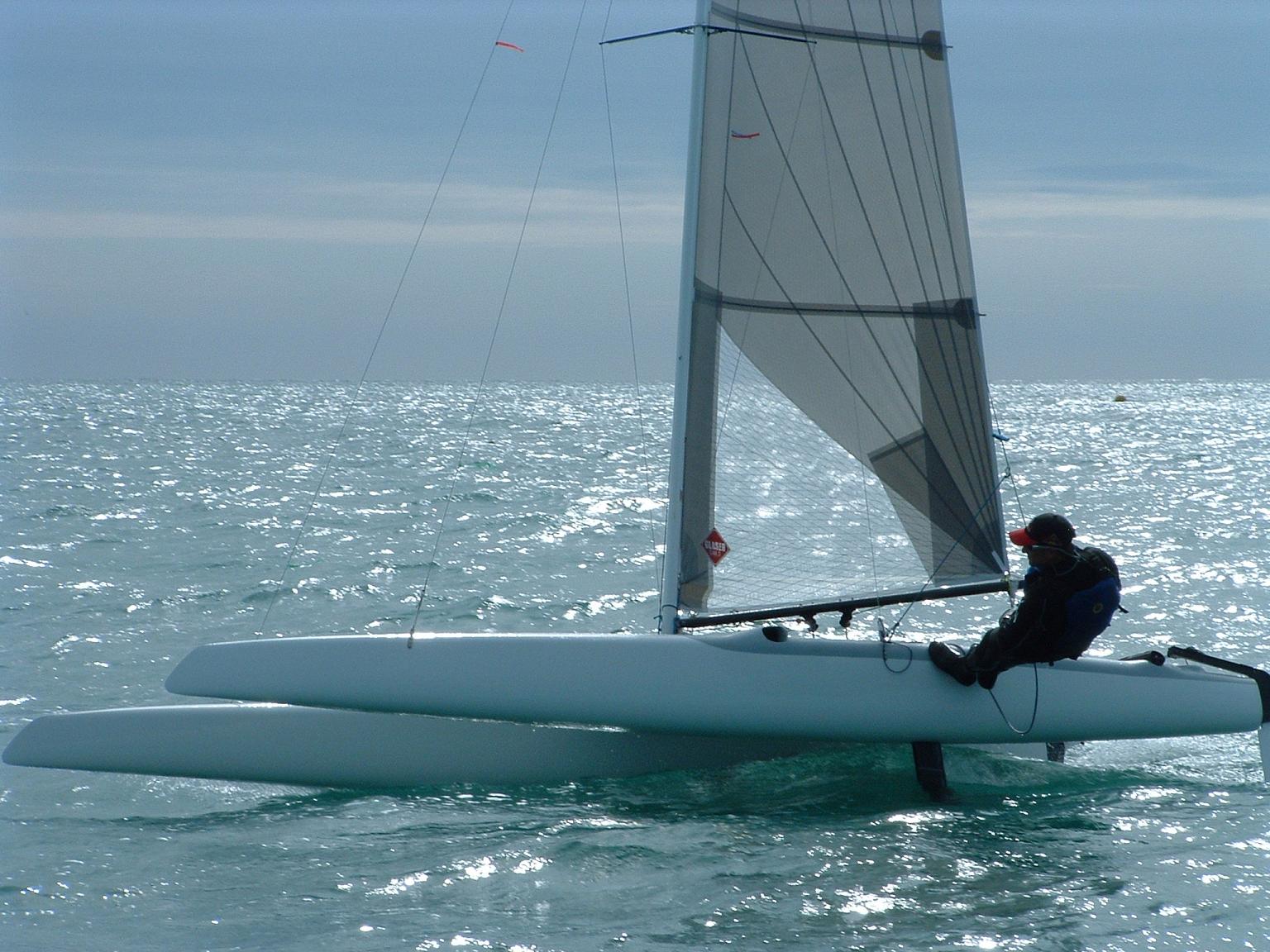
I was scared off the course at Spring Fever last year by two near misses with spinnaker boats, and I doubt if I will ever again sail in a multiple-class regatta unless there is a separate course for the slower boats.
AND I think the fast boats will be happy to have one less obstacle to avoid.
Mary,
The real problem IMO is the poor understanding of the rules by some sailors on the race course and the hazard that poses to others. You could draw the same analogy to driving your compact car on a freeway filled with speeding SUV's driven by drivers talking on cell phones. Not a great place to be unless you are really doing some defensive driving!
OK, I keep saying I'm out of this one. Sayanora!
Bob Hodges

I agree that if you try to roll another boat, you should be prepared to be luffed. Hails are good practice, tend to prevent collisions, and support your position in the protest room, but (with the exception of rule 19) not part of the rules. As you say, the rate of turn is important. It has to be fast enough to be effective, but slow enough to give the other boat room to keep clear. That is a matter of interpretation, and whenever you go into the protest room over a matter of interpretation, you are in jeopardy. There is no "onus" in this situation. The only place in the rules that that presumes judgement one way or the other is RRS 18.2(e). Otherwise, the protest committee finds the facts and applies the rules based on them. If the PC finds that the windward boat capsized due to poor seamanship, then the leeward boat has not committed a foul. If they find that windward boat acted promptly with reasonable skill but was compelled to capsize, then the leeward boat broke RRS 16.1 and will be penalized.
It is virtually impossible for a leeward boat with luffing rights to loose such a protest. Re-read rule 11. It is crystal clear. The leeward boat *CAN* change course and if the windward boat is forced to capsize or whatever he odviously hasn't satisfied the "Keeping clear" definition.
The leeward boat can't luff up and plow straight thru the side of another boat but they can put the flag up!
I have re-posted the rule for your reference:
rule 11: When boats are on the same tack and overlapped, a windward boat shall keep clear of a leeward boat.
The operative words here are "keep clear" as defined:
Keep clear: One boat keeps clear of another if the other can sail her course with no need to take avoiding action and when the boats are overlapped on the same tack, if the leeward boat can change course in both directions without immediatly making contact with the windward boat.
Reaper
Mary:
Don't let them scare you off. Carry a soft cooler with some ice ballons and bean there butt if they try to run over you. One bouncing off there sails will get there attention REAL fast. (LOL)
Doug
I would like to add one thing to this discussion. There is also a book of appeals that sets a precedence for judges on the interpretation of some of the rules based on past cases. If you are really interested on the rules you may want to look at a copy.
As I said earlier in this thread, with a Wave it is more like driving a TRACTOR on a freeway. And you are right, it is not a good place to be. And I won't be.

The US Sailing Appeals book can be purchased from US Sailing Store for $50.00. See item number 13045.
The Case Book, which is a set of definitive rule interpretations is available for download free from ISAF at http:/
Happy reading,
Eric
P.S. Oh, and by the way, the appeals cases are not "precedent", in the same way that English (and US) commonlaw is. Appeals cases do not have the force of rule the way that legal precedent has the force of law. A protest hearing is independent of the hearings that have gone before (but the rule interpretations above are useful nonetheless).

Maugan17,
There's no question that someone should TRY to cause another to capsize...that's not what this is about. It's about one boat trying to protect their wind using the rules that are in place. If I was in a situation where a faster boat was overtaking to weather, I would do my best to luff...that's racing. It doesn't mean that I would force contact or purposely make the other boat flip. If that does happen, the problem/fault lies with the overtaker not being prepared for a defensive luff, and by not knowing how to control his own boat in that situation.
You can't just toss the rules away "trying to be a nice guy"...this can create it's own dangers...people begin to expect that and then we no longer know in advance when the rules will apply and when people will be "nice".
Sailing rules are there to make sailing safe, just like the rules of the road. I get pissed off at four-way stop signs when one person tries to be "nice" and doesn't accept their turn to go across the intersection and instead tries to wave others across...causing mass confusion and danger.
Mike.
I don't really give a crap what the rules say,
If someone causes me to capsize on the course because of some maneuver they pulled and there was nothing I could have done about it, then that person is going to hear about it later.
You're stuck in the "rules of sailing say I can do this" while I'm more in line with the "rules of being a good person and caring for the well-being of others and their property say that I shouldn't."
Too many people think that because their "racing" means that they can be a douchebag and get away with it because they're playing inside the rules. I know my opinion isn't popular amongst those "serious" or "competitive" or "driven" racers.
Again, just so we're clear, I'm not talking about using the rules to give you an advantage on the course, I'm talking about using them to cause an accident that otherwise wouldn't have happened.
How true that is! It can be disastrous to try to be "nice."
A long time ago when Rick and I were sailing a Hobie 18, we had a very bad incident. We were going to weather on starboard tack, heading out to the left side of the course after the start. We wanted to get over to the right side of the course, but we could not tack because there was another Hobie 18 to windward and behind. He had us pinned. So we bore off a little and did a deliberately slow tack to port to wait for him to go by and then headed down so we could go behind him.
Unfortunately, when he saw us tack, he decided to be a nice guy and go below us instead of holding his course. This resulted in a head-on collision that destroyed one of the bows of his brand new Hobie 18.
He confirmed afterward that he was just trying to be a "nice guy."
Well, I'm going to be a little contrary here. I don't think the disasters come as much from being "nice", nor from unfamiliarity with the rules, but more from lack of communication.
For example, last year at Spring Fever, I was sailing downwind on starboard tack, with a Hobie 16 close ahead and slightly to windward. I was headed for the corner, and from they way the guys on the Hobie kept looking back at me, I could tell they wanted to gybe. In this circumstance there was nothing for either of us to gain by sailing on, so I called out "do you want to gybe"?
They answered "Yes", so I told them to go ahead and gybe. They did, and I bore up to clear their transoms. No harm, no foul, and we both benefited.
This year at Spring Fever, I heard many hails of "starboard" and of "hold your course". One skipper even thanked me after I bellowed "starboard" at him 10-15 boatlengths away. At another point, I ducked a boat at speed within a few feet - that would have been a very tense crossing for the other boat had we not already talked.
Letting other boats know your intentions goes a long way to avoiding disasters.
Regards,
Eric
Heading an overtaking boat up is a legitimate tactic, but it is often disavantageous. In match racing, or in a covering situation, go for it. Otherwise, it just winds up costing you time (and therefore places). This true in one-design racing, and especially true in mixed fleets. While you are duking it out with the windward boat, others are passing both of you.
When I sail downwind on my sloop-rig, and a spinnaker boat comes whipping up from behind, I don't head him up. I just try to get the pass over with as quickly and painlessly as possible. Sometimes, I even gybe away. Yes, the rules allow me to luff the other boat, but it's just plain faster not to.
Regards,
Eric
Eric,
I totally agree that communication is very important, even when it is not required by the rules. But in a breeze, voices are being swept away by the wind, and the wind is whistling across people's ears, so often you cannot hear WHAT anybody is saying, or even hear them at all. So communication is not always feasible for boats crossing upwind and downwind in fleets of boats that tack downwind. That is why you have to rely upon people knowing the rules and holding their course if they are the right-of-way boat.
I am very guilty of abusing the rules myself, because when I am a right-of-way boat and I see a big, fast, aggressive, spinnaker boat on a collision course with me, I just slow way down or even park until that boat passes in front of me, and then I try to get going again. That is not the way it should have to happen, but I am very intimidated. I realize my actions could actually be endangering other people when they are expecting me to be proceeding at my normal pace on my normal course.
I am willing to admit this because I am just a wimpy woman, but there are men who feel the same way and will not admit it -- they just stop going to regattas.
Like you said Mary. If a boat with right of way over me and on a collision course slowed down, I would be very surprised and watch it closely wondering what was going on..
Better learn to wolf whistle without fingers, it carries much longer in a breeze than a shout.
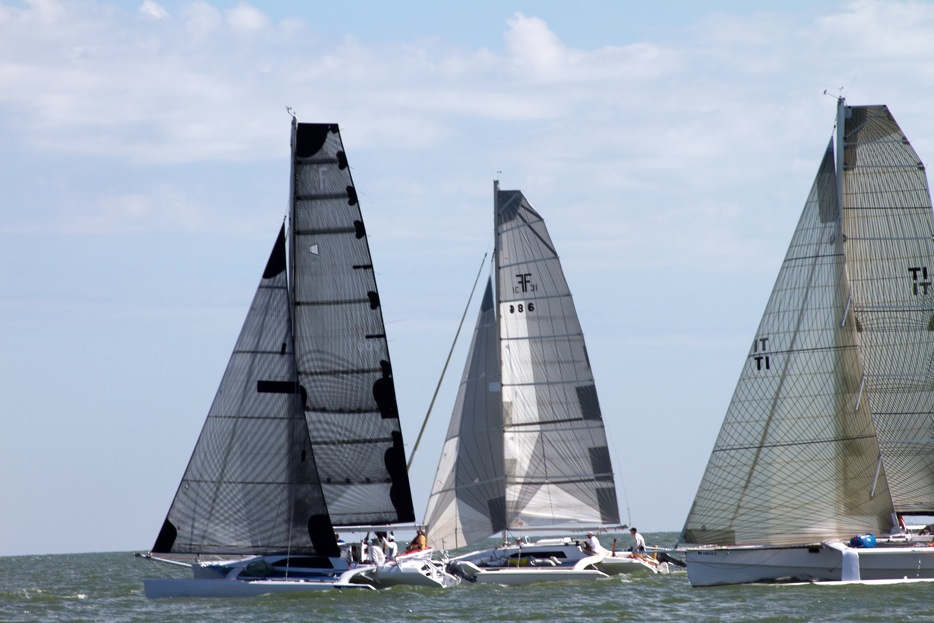
I can totally see why it would be intimidating and anyone who wouldn't be a little scared in a situation like that is braver than me. Ever been out sailing in fog and then hear a powerboat whose engine clearly sounds like the revs are way too high for 10 yard visibility? scares the crap out of me. The same applies to a spin boat or any sailboat for that matter, the visibility isn't always great and you can easily get so absorbed in what is going on on the boat that you don't notice anything else.
Mary,
My first inclination was to suggest ways of overcoming your intimidation (I admit it - as a man I try to fix things), but then it occured to me that intimidation is worth discussing in its own right.
So, for the group: when sailing in multi-class events, what do you think are the causes of such intimidation? What can be done about it? Are there other remedies besides separate courses?
Some of the causes I can think of are inexperience (although I could never accuse Mary of that), not trusting your own abilities, not trusting other boats to keep a lookout, not trusting the other boats know when to keep clear, not trusting the other boats will try to keep clear, not trusting the other boats are capable of keeping clear (you know, the magnetic attraction of fiberglass).
Is it simply a matter of relative boat speed, size, and testosterone level, or is there more to it? What can we do to not frighten people off the racecourse?
I know I used to be a lot more timid around other boats than I am now, and I might inadvertently be scaring others by crossing within my comfort zone - but not theirs. I also have a pretty loud shout. I had no trouble being heard well over 100ft away in 15+kts wind last weekend.
Comments?
Regards,
Eric
I am not so concerned when the OTHER boat has right-of-way, because then I KNOW it is my job to keep clear. The problem is when I DO have right-way and am too timid to assert it.
Is it simply a matter of relative boat speed, size, and testosterone level, or is there more to it? What can we do to not frighten people off the racecourse?
This is getting confusing because posts are crossing. However, it definitely is an issue of boats of greatly disparate speeds. And it is also an issue of not trusting the faster boats, especially those with spinnakers, to watch out for, and try to avoid the slower boats that are going in a different direction and do not have the speed and agility to take evasive action, whether they have right-of-way or not.
Yes, and this will make me wonder what is going on and where the 'trap' is, what is the tactical ploy going on. That the other boat is intimidated and dont trust me enough to keep clear comes a long way down on the list. If I see it of course, but situational awareness is very high on the list when racing! Goes with keeping my head out of the boat and letting the crew worry about boatspeed.
As for intimidation, if the other boat dont see me, I slow down or do whatever is required to avoid a collision, as pr. the rules and common sense. The wolf whistle is handy here, as it carries a long way. But if the other boat is not so close as to be protested under the rules I dont know what to do except striving to keep similar boats on the same courses and not mix them. Alternatively, building opaque spis (I am sure I saw some such a time back).
Keeping the boats separate in smaller handicap events have its owns challenges and problems.