

Yes. That is. "ridiculus ad absurdem."
Ok, lets leave the minimum wind end for awhile. Rick, what would be a good upper limit or agreed situation for a maximum wind? US Coast Guard "Small Craft Advisory?" An open sea situation with limited rescue craft? There should be something tangible (Knot meter reading maybe?) that could be used as a guide for Race Committees? Certainly different boats will have different upper limits too, but when it gets really up there, can an RC actually think it is ok to run races? At what point does a competitor feel comfortable using his own judjment as to what is safe while not missing a start because some RC is going to start regardless of the conditions?

Any good sailor knows that it is not wind strength but sea state that makes sailing impossible. So a upper wind strength limit is just silly. Chalk it up there with any other comments coming from well meant intentions but also lack of experience.
Wouter
"Guide" for the race committee is different from making it official by putting it into the sailing instructions. For instance, in the case of maximum wind limit, 25 knots might be fine on a flat sea, but 18 knots might be too much in high, close-together chop.
And on the light side, 5 knots (or even less) with steady direction might be okay on a flat sea and no current, whereas you might need at least 8 knots if you are also dealing with chop and/or current.
I would agree that it would be helpful to race committees to have detailed, suggested guidelines to assist them in making their decisions -- but those guidelines should not be law. The final decision should be left up to the race committee, and it should not be protestable. IMHO
P.S. I see Wouter beat me to it, regarding sea state.

I agree with what Mary says! It should be up to the Race Committee! Guidelines are great! If the Race Committee decides to run a race, it is then the decision of the skipper whether or not to compete.
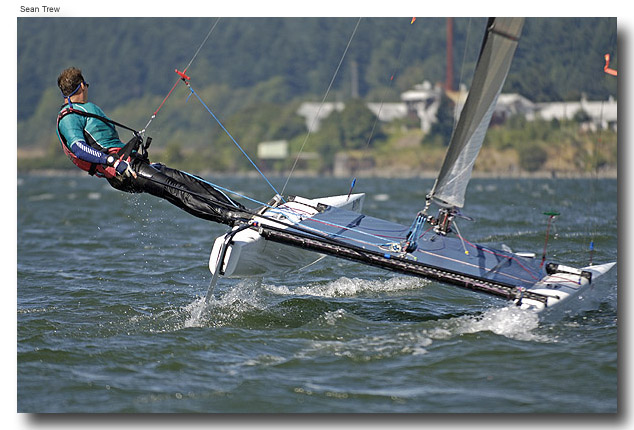
What is the big deal with upper/lower limits. Do not some classes have them? AC boats have an upper limit. A class has upper/lower limit...its part of the rules....
Am i wrong?

WORD!

Quite honestly, there are way too many scenarios to make anything concrete as to what an RC should and shouldn't do. That is why you want to have as experienced a PRO as you can have that has common sense.
Number of support boats, minimum wind speed, maximum wind speed, lightning, big waves, big swells, etc all in varying combinations would make the creation of concrete rules impossible.
I remember the 1995 H16 Worlds in Huatulco Mexico. One day the winds were in the 40s the seas were 10 - 12 feet. The RC boat was a Mexican Navy vessel with a 700# anchor that they could not set. Wally and I, as well as a few others, were blown over in the sheltered cove even before we got out to the ocean. Jeff Alter and Kathy Ward almost lost their lives when their boat pitched and put them and the boat into the rocks. Not a nice place to be but it was a Worlds. Needless to say, no races were run but I bet if they ever got the RC boat anchored they would have tried. It was very frightening even for us.
I do not believe there is any way to make rules that govern this type of stuff and make it pleasing to everyone.
I also believe it should not be the type of stuff that is open to redress. The conditions are the conditions. They are the same for all the competitors.
In the H20 Nationals in Lake Tahoe in 1992 Wally and I had a monster lead rounding the weather mark only to find our very own hole going to the leeward mark and we watched the entire fleet sail right on by us. Our position was definitely prejudiced. Maybe we should have asked for redress since the RC should not have put the course where that hole was. 
It is our (the RC's) decision and responsibility to use common sense and make the most of what the good Lord gives us. Instead of squabbling over this stuff why don't we focus on getting more people educated on how to be a responsible RC and let them do what they volunteer to do.
Mark

Am i wrong?
I believe that Rick addressed the AC weather limits. 
Problems can happen when an RC does not have the best judgment, is being pressured by sponsors, time limits etc. or just doesn't have all of the facts. Some times the RC is not as familiar with the type of boats being raced and what their capabilities are. We are not only talking the best-qualified Pro’s here. Local clubs provide some RC’s. Some kind of (maybe by class) guidelines in the rules may actually relieve an RC from some of this. We had minimums at the 16 North Americans (qualifying round) that were met, but we still didn't race because I (as beach captain) didn't feel it was safe for surf launching. It was blowing 5 knots and over on the course, but on the beach we had 4-5 foot breaking surf and 3-4 knots straight on shore. Now this...is a case where discretion was used.
As you would likely recall Mark, I also was at the Hualtuco event as the factory beach team. I warned of the approaching storm. We did get the agreement to cancel launching boats because we were having difficulties. In any case, it is up to more than the PRO to identify problems, they need to trust in their team on the water too.
Forget about the weather in Huatulco....lets talk about that pool party!!!!!
Margaritas, nudies,the waterbomb slingshot, 36 people on a Hobie 16 in the pool ahhh bliss!
I agree whole-heartedly Matt. It takes more than the experience of the PRO to make these decisions. It is a team effort and unfortunately there is the club stuff that goes on where there is not the support that is usually necessary.
There are no easy answers to this situation. Familiarity with the class is very important, I would agree. That is one of the reasons I have focused on catamaran racing since that is what I know and therefore have the best experience for judging the existing conditions.
Glad to see your interest here Matt. I have always respected your abilities, opinions and servants heart. One of my favorite quotes is from Albert Einstein:
"Great spirits have often encountered violent opposition from mediocre minds."
Hope you are having a Hobie day.
Mark
Matt,
One other thing in response to, "We are not only talking the best-qualified Pro’s here. Local clubs provides some RC’s. Some kind of (maybe by class) guidelines in the rules may actually relieve an RC from some of this."
Last fall we had a new regatta run by a yacht club PRO that never ran a catamaran race before. I made myself available and sat with him on Saturday morning talking about the nuances of Hobie Cat racing. He was much abliged and ran a terrific regatta.
I know at the F18 event I polled a few of the sailors and got their opinions on setting the offset mark, did they like the offset, and even asked a few to let me know how they saw the course and any input they cared to make since I have never sailed a spin boat before and did not know their likes and dislikes.
Sometimes we, as Race Officers, have to humble ourselves and make ourselves available to be educated by the sailors themselves.
Mark
Mark,
Of course I am having a Hobie Day! Every day is a Hobie Day here at Hobie Cat.
Thanks for all of your efforts and experience as PRO! As said many times before, but never enough, volunteers and RC don't get enough thanks. I certainly know the efforts involved in running a regatta. I also hope that Tracie, the organizers, RC and sailors realize that a protest against an RC is not a statement about the sailors (on either side) the event itself, RC or PRO. It is simply an interpretation of rules that someone feels should be reviewed by a jury. I heard plenty of good things about the event back there! Other than it was HOT, HOT, HOT! Lots of good racing went on.
It has been too long Mark. Hope to see you again sometime soon.

So, At the end of the day
What should the Sailing Instructions say to avoid the protest room.
Thanks
Mark
Mark,
IMHO, nothing about wind strength. Nothing to protest or ask redress for.
At major Hobie Cat events... there is nothing in the SIs about minimum wind.
It is simply an unwritten standard that races are not run if there is less than 5 knots.

Not true Matt. The H16 SI's from Ventura have rule 11.5. The 5 knot rule. As you know, on the beach we could hear all the mark boats reporting wind readings and no race was started in less than 5 knots. All the old Si's I have also have the rule. The only different one is from the MEGA that states as I've said before. "The desicion by the RC to start or not start a race is not subject to redress." This would solve the redress question as asked above. My opinion is that there should be the 5 knot rule at 5 day events and the RC should keep readings. If that was done there would be no grounds for redress. If a couple of days go by without any sailing then amend the rule as was done by Mark.
As long as I have been reading the term "as determined by the RC" I have been wondering what that ment. This whole process may clear this up in the future. Let's not blame RC or sailors. Learn something and move on.
My bad. Guess I should actually read those things!
THIS SOUNDS LIKE THE SOLUTION!
Thanks Paul
Couple this with what ever wind range the club, class, PRO wishes and you then you have let racers know what to expect by declaring guidelines for the racing and not rigid standards.
By declaring that these decisions will not wind up in the jury room you don't have to worry about how to measure, where to measure.. when to measure...... Indeed the experience of the RC will be the key factor to a succesful event.
Is there a loophole that I am missing
Mark
After reading the postings here I have to say I am a little bewildered. At first I took the theme of the thread to be a little "tongue in cheek", but it has become apparent from the response from “you guy's (and gals)” in the US that you treat this quite seriously? I have never seen or known of a problem such as this (or the core argument –limits set) ever to have been a problem in sailing/racing in Australia!
For a start, to my knowledge, there are no wind strength limits set for the start or continuation of any race in Australia (apart from a few classes that have an upper limit set, but only for their state or national titles). The responsibility for setting a course is entirely in the hands of the “officer of the day” at the venue, and if a course can be set and the rescue craft can navigate around that course safely then the event is run. Whether a sailors starts, races, and finishes, is entirely their responsibility. The OOD has the right to abandon the race if, in his opinion the conditions become too dangerous (usually based on the abilities of the rescue crews to be able to ensure the safety of the sailors), and he has the right to “shorten the course” (or abandon) if it looks like the conditions are, or have become too light for any one to finish within the standard time limit set for the completion of the race. Every one accepts these conditions (and control by the OOD) and races accordingly with never any recourse to the jury room for situations as described in previous posting here?
The lower wind speed limit rule for sailing is traditionally set for a class of vessels to be used as a guideline by a race committee to ensure that boats have manueverability against current, wave and wind direction and obsticals. Should the RC determine the vessels have manueverabilty to sail around the course and out manuever each other strategically then it is alowable to start the race. Should the RC determine that local conditions are not favorable to run a safe race in speeds over the lower limit due to inability to manuever around obsticals or against currents or heading into waves then the RC has the perogative to delay race. None of these conditions existed. My concerns here with your comments are two fold. 1) Using that term "Drifter"in this thread of dialogue is inappropriate. The only drifting in that race was performed by sailors at the start who did not approach the start strategically with boat speed and timing. Instead they set up on the line in Irons. Waiting for the flag and horn. Once the race began no one had difficulty getting under way. Those who chose the drift on the start tactic were however at a disadvantage because smarter sailors had chosen to approach the race start finish line from a moving "at boat speed" start. In fact many sailors all week committed too early to the line and continued falling off and luffing to hold that line while in Irons. No boat had difficulty making it to the RC start line that day from the beach or from the moment the class flag was raised. 2) Tactics. No one individual boat drifted to an or disadvantage advantage position while the race was underway. Current had no negative effect that day. No drifting occurred. No wind direction oscillations occured. IN fact some boats changed position in the race and the skills of the sailors were tested. It was required that the sailors look back and determine if the fleet or others may be covering thier position and register that information against a choice to choose a different tack on the downwind leg. THis race was not a sprint in the wind it was a very good race requiring fleet tactics of choosing lenth of tack and direction as well as execution of individual boat handling and sail handling technical tactics.
Well said Jack.
Good analysis of what occurred.
Mark