
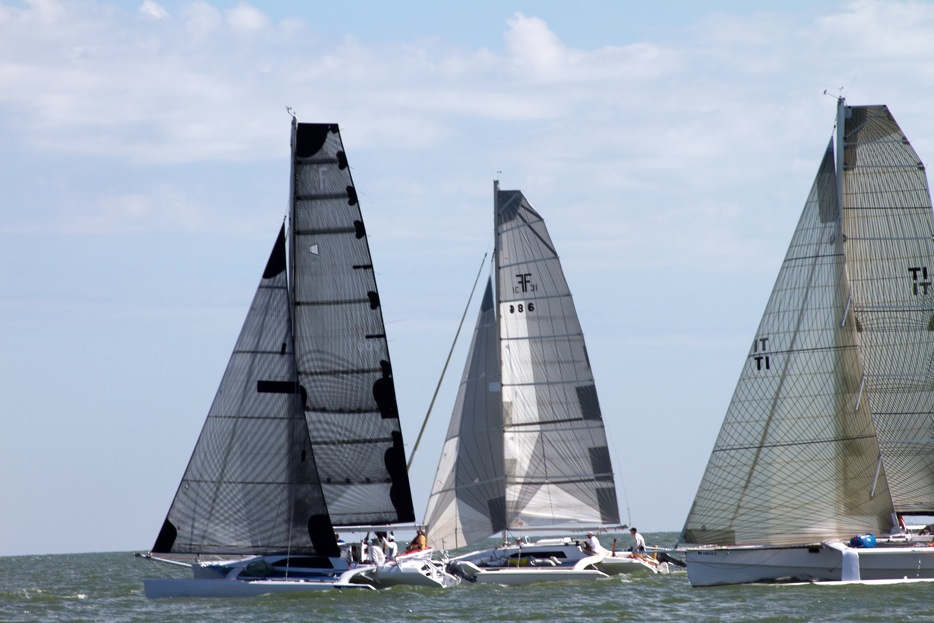
Seems like this is the way of the future, as it seems it should be. They are actually cheaper than radial cut sails because they are less labor intensive (I believe). There is also a good amount of competition because each major sailmaker has its own version (3DL, Tapedrive, etc). of course it hurts the smaller, local, sailmakers.
Anyone have any downsides aside from maybe less durability?

I saw the very first 3DL in action in 1991. I was sailing on the Stars and Stripes wing catamaran in San Diego Bay when Team Dennis Conner hoisted this strange looking clear sail on his AC boat for a very brief period of time. I was working at North Sails One Design at the time and the next day saw all of the execs standing around this sail on the loft floor downstairs. A few weeks later at the
Sailmakers
party I sparked up a conversation with one of the North engineers in charge of 3DL. He acknowledged they had a long way to go. It would be a few more years until they debuted the new technology at the '95 AC.
Fast forward to January 2008, the patent held by Peter Conrad expires. License holders, UK, North and Ullman no longer have to pay the royalties and other manufacturers most notably Dimension Polyant and the China Sail Factory are marketing finished and partially finished membrane sails to small and midsized saillofts.
We've sold some over the past year, all to racing monohulls.
These membranes are manufactured on the same laminators used in the production of sailcloth. The lamination is strong and the fibers are well laid out.
They are a bit more expensive than paneled sails. Someone still needs to operate the machinery, the panels need to be assembled, then finished at the sailloft like a conventional sail.
Will we see this new technology on beach cats? Maybe.
Currently Dimension Polyant is only selling Kevlar membranes. If and when they market Pentex versions will you see it become more mainstream.
Chip Buck
Whirlwind Sails

I did a little reading up on this.. looks pretty neat. i would love to save weight and gain strength !!! If the cost comes down with
economies of scale
then i am in!!!! (maybe) <img src="<>/smile.gif" alt="smile" title="smile" height="15" width="15" />
on another note... in my dream future... i want solar panel main sails to power my radio, radar ./sonar etc, and my jib to have a flexible HDTV display on it!!! that way i can get paid to advertise, project lights when my radar (or sonar) suggest it and i can watch the game when i am taking a break from sailing! I know.... i am dreaming... but i am at work, at my desk... what do you expect me to do? work???

Chip,
Thanks for your post... nice to see a professional's inside view.
Going back and looking now, they do seem to be a little more expensive for the material.
As far as beach cats... there is a pic of a wave with a LP sail on the catsailor front page somewhere. The loads on a wave sail have to be fierce. <img src="<>/smile.gif" alt="smile" title="smile" height="15" width="15" />
Although the labor to create the fabric is significant, the finishing part of the sail is a lot less than doing a radial cut sail.
There was some photos of a load path sail on a Mosquito some time ago. Looked really nice.
Load path sails still need the mylar sheets assembled much like a crosscut sail. Then the strings are put on and the sail gets battens, luff, egde trim, sail number etc installed. A trained sailmaker can glue up the panels in a radial sail pretty fast, and the sewing ladies are not that expensive <img src="<>/wink.gif" alt="wink" title="wink" height="15" width="15" />

Yeah, 3DL has been around for quite some time now. North has even created a rotating process where they can make smaller 3DL sails easier. The
old
and larger 3DL's are made essentially on a big
floor
where a computer lays the fibers out. The new smaller process does it on a rotating drum, takes up less space.
The Batchelors had some Norths on a F18 a couple of years ago. I don't remember if they were panneled of 3DL.

Does anyone know how they make the fabric? Wether it be Pentax or Mylar, Kevlar or whatever? It certainly would be interesting to create a machine which could make the material in the proper shape to start with. Put sailmakers out of business sort of. In that no stitching would ever be needed. But you would still need to design the shape.
you still need to install the tapes (edges) and patches (corners) for reinforcement. Also webbing and grommets. there is still plenty for a sailmaker to do but not nearly as much as before. I guess machines could do all of that too though.
when I ordered the kit to make my screecher I was offered a Bainbridge LP sail which would have only required me to do the reinforcements. The cost was about 10% more for the LP sail (roughly)than an expensive
crosscut laminate
material. The lp sail which would have only required the finishing. Since I do this for fun/hobby I didn't see much fun in just finishing the sail. However, I find sewing the patches and tapes the harder aspect of putting the sail together in a confined space. Sewing the patches on is difficult to do without creating bulging due to the fact you have to roll 9 layers of fabric to fit it under the arm of the machine.

Tony Arends (Racer X sails) made one for his A cat late last summer. It was a beautiful sail but I don't know if he decided that the extra cost justified any performance increase. It looked like king kong could not pull it apart though. On boats with more powerful rigs... it could offer advantages. I think that on the very stiff carbon N20 mast... you might actually be able to bend it with his string sail.
I am not sure... but the F18 and Tornado classes may ban string sails under their
approved sail cloth rule
which would have crushed development in this area.
What fabric would that be? The sail is built by gluing sheets of mylar together like a crosscut dacron sails. Then it is put on a mould and the fibers are put in place. Then it is closed off with glue or a layer of mylar or scrim. UK had a process where they just taped the fibers on with a tape dispenser <img src="<>/grin.gif" alt="grin" title="grin" height="15" width="15" />
So it is mylar and fibers of choice, mainly carbon I think.
There are several variations of the process. Some have the panels pre-setup with fibers in the right layout and then assemble the panels to a sail much like a crosscut sail. Then you dont have continous fibers running the length of the sail, but still lighter and better shape holding than tri-radial or Maxx/Flex sails.
I bet North would love to get a machine to build the sails with no human hands touching it. Humans make errors while machines do as told (mostly). As of up til now, they have not managed to although the 3DLr is a step on the way. Myself I like having several sailmakers and beeing able to buy the materials I need to build my own sails.

as far as I understand, these
single piece
sails cannot be changed once they are fabricated. A cross cut sail can be tested and if necessary changed by a sailmaker to your wishes. Crosscut sails can be stiff enough, if they are from the right material like Maxx, at least I think so, but I have never sailed a this material. The seams are more or less parallel to the airstream, hence less drag than a radial sail. If the seams are at the same place as the battens, the friction drag is the same as for a single piece sail, which has battens as well. Since a single piece sail has no seams it is stronger, but how much would be the weight benefit for 20sqm of equal material? 100g or 200g...
At the end it is the same choice like for a suit: an expensive, but off the shelf suit or a made-to-measure suit. Even with less exclusive material the tailored suit will always fit better.
So, to fuel the discusion, I would say that such a single piece sail is an expensive, less durable sail which is slightly lighter and aerodynamic less efficient (=slower) than a conventional sail, which you figured out with your sailmaker.
Or you spend enough money and time for testing until you get the right 3DL or what ever sail to fit your need.
Cheers,
Klaus
How many people have had a real discussion with their sailmaker regarding how they want the sail cut? I think you might be able to work with a local sailmaker on shape/etc but then your local sailmaker may not have a lot of experience with multihull sails so you are taking a risk there. The 3 times I have ordered sails no one ever asked about where I sail, how I sail, how much I weigh, etc. I have told them but I seriously doubt they altered anything based on my comments. Maybe it is just me...
Hi Klaus,
the thing with load path sails is that they are light, and hold their shape through the different windspeeds better. A crosscut dacron shape will change its shape and become fuller in gusts, not what we want. They also have the same benefit of less drag as the crosscut sails.
I sailed with a Maxx Pen09 mainsail on the Tornado the last season. The cloth was a bit on the light side and you could see how it flexed compared to a tri-radial pentex of a heavier cloth. However, becouse of the ease of construction and the option to select different weights and fibers on the F16s we are building, I'll want Maxx or Flexx the next time over <img src="<>/smile.gif" alt="smile" title="smile" height="15" width="15" />
Maybe it's your sail maker!
My sail maker measured the mast stiffness/ bend, took my weight into consideration and built the luff curve accordingly.
Now... can I actually exploit all of this value... No. I think I have screwed up my mast bend for a season... but that's a different problem.

The Batchelors had some Norths on a F18 a couple of years ago. I don't remember if they were panneled of 3DL.
The sails were paneled and slow. They looked to be cut too flat to me.
UK and North membrane sails have fibers running continuous from corner to corner. Both rely on cross-cut mylar in some form or another. North lays single mylar on the plug, then strings, and the other layer of mylar. A vacuum is created and then the sail is cured. This process has limited pressure but a more controlled shape control. The UK Tape Drive sails use off the shelf laminate cloth constructed into a cross-cut sail then tapes are applied in the
load
path.
Dimension Polyant's D4 technology constructs large single sheet sails that are flat at first then cut and assembled into cross-cut sails. Seams are hidden under batten pockets.
Other construction techniques that are starting to take off are membrane sails constructed panel by panel then assembled.
The sail design is generated by either a program developed for these machines where from start to finish the design is controled inside a single application or an older program generates the cross-cut design then imported into the
load path
application.
These newer membranes are produced on lamination machines that apply more pressure and heat than the North 3DL system. The adhesives used are stronger than the fabric with no failures at seams.
Flex and Maxx are cross-cut laminate fabrics. Flex is symmetrical, Maxx is asymmetrical. I have built lots of Flex sails and only one Maxx. I prefer Flex. It's better.
www.calvertsails.com Check out the colored load path sails and that should give a little insight.
Colored 3M tapes. Sails developed by Tom Barry of Sail Technology in St. Petersburg, FL for Bainbridge. Same loft that is now housing Calverts office.

my
Sail distributor
Asked me so many questions on my new sails that i thought i could have made the sail myself quicker, but I am extremely pleased with my
Surf City Sails
and the questions Jeremy asked helped make the sail comform to F-18 standards and my sailing style.
but those sails were from 3 different sailmakers!
Thanks Chip, that's hugely informative. I'm sure there's lotsa guys appreciating your input as much as I do.
Dave
Dave
Agreed... it is great data Chip has provided, and wonderful to hear an insiders perspective (as mentioned above)

Calvert sent me a prototype sail for the Wave Nationals that was built in that manner, but it arrived too late for testing. I did use it a couple of times in our series races.
Seems to have a lot of potential. Meanwhile, Calvert is now writing an article on the subject that will be in an upcoming issue of the magazine we publish -- Catamaran Sailor Magazine.
Oh, Yes! We do publish a real, sitdown on the john and read, hard paper magazine that we put out almost monthly (9 issues a year, around 50 pages)
If you have enjoyed these Forums, you will really enjoy the magazine (little advertising here for the home field)
To subscribe, go to
https:/
Thanks,
Rick