

David,
when you increase the power by making the foil deeper (more draft) the drag will also increase. If we say the windspeed is relatively constant there will be a given draft which have the best lift to drag ratio for that windspeed. If we sail with more draft than optimum, we will be slower than somebody with optimum draft or even less than optimum as they have less power but also far less drag.
Perhaps I should do a graph..
This is all very theorethical and in real life it is most important before you get out on the trapeze. It is especially important in light winds in my opinion!
I'll dare to say something about the second question as well. Draft and airspeed are also part of deciding the point of stall to a greater or lesser degree depending largely on the speeds and angles you work with. That is my understanding at least.
when you increase the power by making the foil deeper (more draft) the drag will also increase. If we say the windspeed is relatively constant there will be a given draft which have the best lift to drag ratio for that windspeed. If we sail with more draft than optimum, we will be slower than somebody with optimum draft or even less than optimum as they have less power but also far less drag.
Perhaps I should do a graph..
This is all very theorethical and in real life it is most important before you get out on the trapeze. It is especially important in light winds in my opinion!
I'll dare to say something about the second question as well. Draft and airspeed are also part of deciding the point of stall to a greater or lesser degree depending largely on the speeds and angles you work with. That is my understanding at least.
There is a good trick you can use this full camber for. In light winds if the leg is long enough and you are having trouble catching/overtaking a nearby boat ahead when sailing to windward, try easing the outhaul and downhaul to increase camber and start to pinch slightly. If done properly you fall back a little but you lift above the other boat. You can then bear off a little and trim accordingly for greater boatspeed. This helps get you past the other boat. If they try luffing they slow down, plus you have more lift from your boards with the increased boatspeed.
Cheshirecatman
when you increase the power by making the foil deeper (more draft) the drag will also increase. If we say the windspeed is relatively constant there will be a given draft which have the best lift to drag ratio for that windspeed. If we sail with more draft than optimum, we will be slower than somebody with optimum draft or even less than optimum as they have less power but also far less drag.
Perhaps I should do a graph..
This is all very theorethical and in real life it is most important before you get out on the trapeze. It is especially important in light winds in my opinion!
I'll dare to say something about the second question as well. Draft and airspeed are also part of deciding the point of stall to a greater or lesser degree depending largely on the speeds and angles you work with. That is my understanding at least.
sounds fair....
Hi David,
Actually, there are many factors which let the sail or parts of the sail stall. Some are linked to the local angle of attack, the draft (camber), roughness, mast shape and perturbations and to a small amount to the speed (actually Reynolds number). Others are linked to the plan form of the sail and the its aspect ratio among many others.
The good thing of all these parameters is, that you don't have to care about them as long as you know if and where your sails stalls and how to stop it. Put tell tales in your sail and at the leech. They cause very very little extra drag, so don't be thrifty. I have them at three different heights each with a sequence of four or five tell tales from about 10cm behind the luff to the leech. With this (and a minimum transparancy of the sail of course) you will easly see the effect of sheet, downhaul and outhaul tension and mastrotation and -prebend.
Avoid stalling on the leeward side of the sail at upwind courses, if possible. But you may accept some stalling at the leeward leech if you are on a reach or going downwind. Stalling on the windward side is harmless and an indicator that you can tighten the sheet (if you are not over powered of course).
Hope that answers your question.
Cheers,
Klaus
Hi Rolf and all,
Finally I made some pictures of my sail. I was in a hurry because of an approaching thunder storm, so I didn't have the time to play around and I couldn't test the new diamond setting on the water.
The main sheet was tight, downhaul open, rotation open (at least should be open), outhaul tight and the diamonds close to slack. Analysed with your eyes, should I be able to hook the top leech more than that? Thanks.
Cheers,
Klaus
and #2
Sail doesn't have a good shape.
Using a tape measure with the sail laying flat on the ground I mark the sail at my max draft position. I use sticky back sailcloth, 3 on each side, contrasting colour to sail colour. I would relocate your tell tales to Max draft, one 15cm closer to the mast and a couple on the leech side of Max draft, same spacing. Should be easy to tune your sail with that setup and a couple of leech ribbons.
I read a quote from Dennis Conner once to the effect of
only an idiot uses the battens that come with a sail
. Typically blunt but it is a good point. Battens need work too.
Darryn
Mozzie
1782
Hi Darryn,
thanks for the hints. Please could you specify what is wrong with sail shape and battens (e.g. too much camber, too flat, too hard, too soft, etc.)? Maybe you have a picture of a well shaped sail, which you want to post.
There are tell tales in the sail, but the poor quality of the digital camera makes them hard to see. However I know where and when the sail stalls (just above the boom). But I am not (yet) able to stall the sail at the top as well (e.g. cannot close the leech enough?).
Thanks.
Cheers,
Klaus
Looks to me like max draft is too far back at the bottom of the sail and too far forward towards the top.
At the second from top batten the leach seems to hook inwards. I would try a stiffer batten.
Try sanding the bottom batten to encourage some bend at max draft. Not much sanding. The batten also doesn't exit the batten holder on the luff squarely. Loose?
Looks like it needs more downhaul. Some more pics with increasing amounts of downhaul and mainsheet tension would be interesting. Force your rotation to your normal upwind setting. Might be all your sail needs as there is not much mast bend. Position your boat on a beat when you take the pics, need some wind too, hold the boat down. <img src=

alt=
/>
Marking your sail and moving your telltales takes the guesswork out of setting your sail up.
Strangely I have some pictures of mainsails from the same angle <img src=

alt=
/> I will find a real ugly one and we can pick it to bits.
Darryn
Mozzie
1782
Good sail, but not setup right.
Whats wrong?
Darryn
Mozzie
1782

to much pre-bend causing the draft to move forward?

Whats wrong?
Darryn
Mozzie
1782
Looks like the top is closed. Maybe a lot of prebend and no rotation?
Regardless of what I think, I believe the direction we're going in on this thread (photos with answers) is GENIOUS.
Keep it up!

Whats wrong?
Darryn
Mozzie
1782
Lot of cunningham tension and slack diamond wires (or is this an optical effect?). Very little rotation.
Klaus, does the sail stall first above the boom on the windward side when pointing or on the leeward side when footing?
On the leeward side when footing. For light wind sailing I woule like to stall the whole sail, not only the lower part.
Cheers,
Klaus
So if we are talking about 5knts+ (no laminar boundary layer) you want a fuller sail downstairs and a flatter sail upstairs. I would begin loosening a bit of outhaul (which gives you the lower part) and maybe try with a little more of rotation (which combined with sheet tension gives you the upper part). If the diamond wires are almost slack, maybe you want to try a little bit more of prebend by applying diamond tension, so the mast follows the luff curve better (I think a little of prebend is necessary in all winds). Cheers, Claus <img src=

alt=
/>
By the way, a nice discussion about under/over rotation and wingmasts can be found here: http:/
that's a good link. Actually my problem is not how the best trim would look like in theory, but how can I close my leech in reality.
For strong wind my sail looks like I wish. In light winds I couldn't close my leech as much as I wished (with tight main sheet and open downhaul). Maybe my wish of a closed leech is not realistic at all, but with your suggestions it could be that the battens in the top are too stiff or I still have too much pre-bend or the sail cut is not ok. Hopefully I will have better wind next week end, so I can figure it out and make some more pictures. So far thanks for your comments.
Cheers,
Klaus
I spent 1 minute with accumeasure (download on the Uk Halsey site), result attached. No significant twist in that mainsail, but you really should flip the boat over when taking photos like this, so you can get some force pulling on the leech.
Lots of gotchas to look out for in that analyzis, especially the top one where I dont know the angle of the batten! I would say the sail is a bit deep for my taste all over, but the twist profile is where I would expect it to be with no kind of force pulling on the leech.
I think your problem is not the leech but the sail shape in the lower part, i.e. chamber too much aft and too flat close to the boom.
Whats wrong?
Darryn
Mozzie
1782
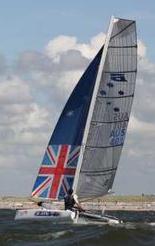
In this photo downhaul and mainsheet are cranked on as hard as possible, much more then sailing setting, still cannot pull the depth out of the lower part of the sail. We decided the mast wasn't bending enough below hound fitting to suit the luff curve so Gordon (former owner in pictured) recut the luff curve in that area. The sail is now competitive and has won races against other Mozzies, last by a long way before recut.
Darryn
Mozzie
1782
Darryn,
Do you by chance have a photo before the recut?
The mozzie mast is quiet a different animal to the F16 mast.!
Marcus
Thanks Rolf,
as I said, I don't how to use this numbers. But I have found a pictures of Gilos Blade Sail with open downhaul and it looks pretty much like my sail, at least in my eyes.
I agree with the excessive camber, but with the downhaul I can reduce it quite efficient. No pics in the moment, sorry.
I will continue with on the water testing, because I can understand what tell-tales tell to me.
Claus,
I tried various outhaul tension (on the water) and I am pretty sure that neither the sail is to flat there nor is the camber to much aft. Both more camber and more forward position of camber let the bottom stall earlier.
Thanks again for your input.
Cheers,
Klaus

From the pics I think your leech is too tight.
The larger the squaretop is the more leech twist you want
see
.
I write
see
as in this case it is different from actually having more leech twist. Basically the twist angle is the same but the large head shows more falling away to leeward at its tip.
Wouter
Klaus, where are you sailing? I'd like to have a look at your sail in flesh since I believe my A-Kat sail has the same problem.
Baltic,
Very good idea. I will give you a call later.
Wouter,
I agree with you for upwind courses. But if I am on a reach, drag doesn't matter, only lift until you can't hold the heeling moment any more. And you get the maximum lift out of a sail or wing, if you bring all parts of it close to stall at the same time. And exactly for this condition I want (or I hope at least) to set up the sail as well. I can always open my leech with the downhaul for the upwind leg.
Maybe it is not possible to stall the top with a square head sail + wing mast and without jib (which protects the lower and middle part of th emain from stalling) <img src=

alt=
/>, but before I make early assumptions I will listen if you guys can stall the top of a cat rigged square headed and wing masted boat.
Cheers,
Klaus
Do you by chance have a photo before the recut?
The mozzie mast is quiet a different animal to the F16 mast.!
Marcus
Hi Marcus, that is the photo before the recut. Looking for the ability to flatten the sail completely, a small pocket down low is Ok but the depth extending all the way up to the hound fitting with all adjustments maxed means that when downhaul and mainsheet are eased to normal sailing positions you cannot point. Fast downwind but low VMG upwind. I'm sure you know this already with your sailmaking skills, I'm putting this on here for those who might not.
Mozzie pear shape mast and pin head sail is very different to F16 wing mast and square top which this topic is refocusing on, a cue for a timely exit I think <img src=
alt=
/>
Darryn
Mozzie
1782