

So I started on a Hobie 18 not all that long ago and I used to always stand on the daggers to get it righted. When I moved to the I20 I did the same thing. The boards on those boards were solid and hardly moved with my weight.
This fall I capsized the C2 while solo I raised some eyebrows when I stood on the end of the board to get the boat back up.
Is this bad practice? My main concerns are that I might slip and fall on the board and get cut, however is my 230lbs enough to make a board fail?

This fall I capsized the C2 while solo I raised some eyebrows when I stood on the end of the board to get the boat back up.
Is this bad practice? My main concerns are that I might slip and fall on the board and get cut, however is my 230lbs enough to make a board fail?
It's not worth the $1200 to find out if the board can support my weight so I don't stand on it.
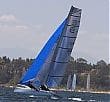
The c2 boards are heavy and very solid pieces of carbon... I would be much more concerned about your dagger wells that are only glass. the boards are quite narrow so there is a lot of pressure in a very small area of support.

Where's Sam when you need to calculate what the working loads are on the dagger @ 10knots compared to a 230lbs dude?

I'll tell you right now. It's a metric fuckton whilst sailing. Unless you're a gigantic fatass, I wouldn't worry about it too much. I don't know how effective it is to do so, vs standing on the hull and laying out flat.
And yeah, where is Sam. I've been meaning to ask him about his DLG project.
Hey, did you see that quadra-copter in Boat US magazine that FLOATS?
For those not familar with the Imperical Measurement Standard
Metric Fuckton
Metric Fuckton
More properly,
Metric Fucktonne.
The Fuckton is the Imperial standard for the measurement of fuckweight, while the Fucktonne, in contrast, constitutes the Metric measure of fuckmass.
Generally used to imply superlative quantity with the Metric standard included to emphasise this point. The inclusion of the term is, however, fundamentally a misuse of that standard, as the Imperial Fuckton (2000 Imperial Fuckpounds) denotes a slightly greater measure of fuckweight within Earth's gravitational pull than does the Metric Fuckton (1000 Metric Fuckilograms).
I've got a Metric Fucktonne of this stuff to finish before Monday, or I'm fucked indeed.

Dave, you're a fine wordsmith
You folks need to watch
The Late Late Show
with Craig Fergason, and learn the proper use of foreign country flags!
not me... Google, I'm too lazy to come up with that stuff.

Thanks for the clarification Dave. I had some idea what a fuckton was, but now, thanks to you, I know.
Kevin, it is my pleasure to enhance and brighten the days of those around me. I don't care what Jake Kohl says I'm a fuc@king delight to be around.

Kevin, it is my pleasure to enhance and brighten the days of those around me. I don't care what Jake Kohl says I'm a fuc@king delight to be around.
I said no such thing! I merely implied that you can be a little grampy at times.

The Late Late Show
with Craig Fergason, and learn the proper use of foreign country flags!
Fun with flags...
coitus

Calculating (or at least approximating) the sailing load on the dagger board is done by analyzing the static forces/moments.
The righting moment of the boat can be approximated by estimating the location of the CG of the boat itself and the crew and multiplying the horizontal distance of the CG from the leeward hull....CG of boat = 400LB x 4ft= 1600 lb-ft. CG crew = 350LB x 12ft = 4,200 lb-ft. Total righting moment = 5,800 lb-ft.
To fly a hull, the rig must generate a heeling moment equal to the righting moment. If you estimate the height of the CE for the rig at 15 ft above the hull, then you can calculate the side force of the rig.
Side force = 5,800 lb-ft / 15 ft = 387 LB.
Since the daggerboard must produce lateral resistance to counter the side force of the rig, the board must be capable of supporting this load at it's CE (of course the hull and rudder also contribute to the lateral resistance, but for the purpose of approximation, one can assume the board supports the entire load). If you assume that the CE of the daggerboard is 2.5 ft below the hull, then the board should be capable of supporting 387 lb at a distance of 2.5 ft from the bottom of the hull. At a distance of 1.25 feet from the bottom of the hull, it would support a load of 770 lb and at a distance of 5 feet from the hull, it would support a load of 193 lb.
sm
wasn't there a protracted discussion related to forces some time ago in a different thread?
It related to whether it was better to run the righting line over the hull vs. the edge of underside of the beam?
The discussion had stick figures and force diagrams, too...

There have been several.
Tami posted this info - Some aspects of structural engineering of dagger boards
It related to whether it was better to run the righting line over the hull vs. the edge of underside of the beam?
The discussion had stick figures and force diagrams, too...