

 There is a Hawaiian Hobie sailor doing some interesting things to his Hobie 17. He is attempting to reduce the possibility of capsize, while making the boat more comfortable for sailors with limited mobility, or who would like more back support.
He calls it the TORUSTM (Tip Over Resisting and Righting System).

Yeah, those wings wont take the load.
I'm going to put this guy's address down, so I can sell him a pair of wings when those things snap, or his hull holes start to give.
I was wondering about that. At speed, when the leeward float touches the water, the additional drag will put backforce on the wing it might not be able to handle.
not only the backforce, but when the sh*t hits the water, thats a hell of a lot of upward force on those wing supports and the wing tube holes in the hulls. My experience with those things is to trust them as far as you can throw them. Luckily, they are pretty light (the wings), so therein lies the problem 😛

Can you say pitchpole?
I have to applaud this guy's efforts however. I admit that I've thought about adding floatation to the wings, but I was thinking about using some form of closed cell foam within the wing supports. But to actually rely on the wings to provide righting moment in this fashion is asking for trouble IMO.
On a H17, you shouldn't be dipping the wings in the water anyways.
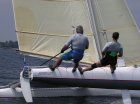
I applaud the effort, but no thank-you, back to the drawing board.

If the boat does turtle, I'd be afraid that the floats would make it harder to right.
well you could unclip one float.
If you could get to it before the wing bent itself upside down.

I dont think the idea is to hold the entire weight of the boat on the outrigger float. Out there on the leewared float the righting force is very small, as there is someone trapezing on the other side. Now I can't say how structurally rigid these wings are, but if they can hold one or two people up hiking out I would imagine that they are stronger than Q-tips that u guys suggest. Or maybe not?
The pitchpoling from drag in the water was a huge concern for me when I made my trap seats, and I was scared to fly the hull on my 16 for that reason. But when I did, and dropped the leeward hull a foot under with the trapseat submerged (with 4 ppl on on about 40-50km wind) the boat moved in slo-motion. It was very easy to react by steering back into the wind, and the boat gently returned to a better attitude - I didn't have to even let out the main. It seemed to act like a safety brake and a danger indicator all in one. I presume that not reacting to pull a boat out from going over any further could result in big trouble, but the outrigged trapseat gave a good margin of warning for me to react - the seat goes in, back off. There were no rude surprises, but I can only assume that this design might behave similar.
Ngree:
The wings are rated to withstand 350lbs total. The problem with this design is, when the boat is sideways in the water, the force is directed in the complete opposite of when there is a person or two out there. Believe me I have severe concerns with having two people out on the wing. I usually leave the crew on the hull and sit on the wing myself because A) its drier and 2) I can see better from up there. If the force due to these TORUS thingies were applied in the same direction as a crew sitting on the wing, I wouldn't have a problem, but this is simply not the case. The force is being supplied in the opposite direction for which the wings were designed.
You would know better than I if the benches are structural or just clip on, and looking closer I would agree that they need a reinforcing bar somehow to actually be able to use the buoyancy of those floats. But if he's using them only for when he gets a little off balance to prevent a full-blown capsize they may hold. I wouldn't patent something with a "may hold" level of certainty, though. BTW, can u lift a 17 by the wings, a person lifting on either side?
uhh, I wouldn't try.
the wings would fall out due to gravity.
And like I said before, thats putting force on the wings in the opposite direction for which is was intended. I see what you're getting at though, and it would be interesting to see, but I'm not volunteering my boat or set of wings to try it.
FYI, one of the wing tubes on my 17 has bent from me leaning on it during a tack. The stuff isn't very structurally sound imo.
 Turns out the concerns about the strength of Hobie 17 wings are correct, at least when the boat is pushed onto rocks by 90 mph winds!
Original TORUS article