

Following the presentation by Dick Rose on Saturday at the AGM for the Gulf Yachting Association, I heard bar talk regarding a
White Shark Rule
that is being investigated and considered. An example in context for this forum could be the scenario of a catamaran going over during a buoy race. The crew is having difficulty righting the cat, and a 'safety' boat offers assistance by lifting the mast out of the water to right the vessel. The team continues racing to the Finish Line.
Currently, the automatic ruling would dictate a DNF. This new approach that Mr. Rose mentioned would allow the RComm boat to render assistance without penalty as long as the act did not give the rescued boat any
advantage or gain
over the other competitors.
The dark side of this might be that if multiple boats are struck down by the same windline and a boat is late in receiving assistance, there could be grounds for material prejudice.
The bright side scenario is that RComms will endeavor to add a safety boat or two for the regatta, and the youth sailors would not be penalized for trying. Even the 'seasoned' sailors would not be penalized for receiving the assistance.
In other sports, athletes can be taken out and then returned for action during the game. Why should sailing athletes be penalized when the time factor already limits their chances?
Why should we use assistance as a penalty?

That's a great question Bert!
My opinion would be that the righting assistance = dsq is not a penalty... it's a disqualification for a lack of seamanship. Regattas are won by the best most consistent sailor (they might never win a race!). This is the nature of the game and changing the outside assitance rule would be a fundamental change in the nature of the game.
The practical problem would be that coach and spectator boats would now be part of the racing game.... Now they are on call by the PRO for safety reasons.... With your white shark rule.... a teams personal guardian angel would shadow you up the course and then race to help you get back in the game when you screw up.
I distinguish a penalty from a dsq... A penalty is a circle on the water or a time hit on a distance race. A dsq is for events that would fundamentally change the game. (Like outside assitance)
YMMV

We use this rule here on the west coast for all junior teams. If a Youth team flips they may receive assistance without penalty.
As for a adult team it is still help = DSQ
Happened to me at the worlds and I had no problem with that. Thankfully with 15 years of racing that was the first time I ever needed assistance righting my boat.

I'm with you, Rich.
The youth events would benefit by having this (although I'd probably suggest it not be used for ranking events like nationals or whatever that equivalent is)
On the adult section, a DSQ for outside assistance would be the norm. I doubt there would be many circumstances that adults would need the outside assistance anyway, except for gear failure or injury?
My thought is that with youth events, the directive should be safe and fun skill development, not necessarily sanctions and DSQs

As for a adult team it is still help = DSQ
Happened to me at the worlds and I had no problem with that. Thankfully with 15 years of racing that was the first time I ever needed assistance righting my boat.
Does this include youth teams participating in youth ONLY events or any event?
Any event in Hobie Division 3 runs that rule. It helps to keep the spirits up if a youth team makes a mistake. We have very few Youth only events here.

Lack of safety boats has nothing to do with this rule. I've never heard anyone say, let's not have safety boats because we will DSQ someone...
I strongly believe that our rules (including SIs) should reflect what the competitors want (barring consensus, should arrive at what is most fair). I'm mixed on this one. I can see pros and cons to both sides, and there are no one-size-fits-all answers (think 60+ boat fleets, heavy air, etc.).
Mike

For what it's worth, the 2005-2008 rules changed rule 41 (Outside Help) to allow
help as provided for in rule 1
. Rule 1 says (in part)
A boat or competitor shall give all possible help to any person or vessel in danger
.
The guidelines for race committee passed down from US SAILING interpreted
in danger
to include capsized boats and crew in the water. Therefore, a boat that received righting assistance from race committee was permitted to continue racing without penalty. Doing race committee during that time, I assisted capsized boats several times and told them that they could continue racing.
That rule, however, was removed in the 2009-2012 RRS. So, in 2009, a boat could no longer receive outside help after capsizing without breaking rule 41. Boats were obligated to retire, or be subject to protest (and possible disqualification). The 2013-2016 rules are the same.
It sounds like Dick Rose advocates a change back to the 2009 style of rule 41. Although there may potentially be fairness issues, I generally agree.
You can implement this change in sailing instructions by adding something like:
as long as she does not gain a significant advantage, help as provided for in rule 1 or assistance righting a capsized boat or retrieving crew in the water;
. This changes rule 41.
Regards,
Eric
Interesting. I know of another case where it was determined by very senior judges that a capsized boat may be given a finish position if it drifts across the line because that is a normal position for a dinghy...
Mike
A few years back, there was a situation where a laser capsized immediately in front of the finish line, and current carried it across before the sailor righted it. There was some argument as to whether or not capsized was
in normal position
, but that discussion missed the point. Take a careful read of the definition of finish:
Note the position of the first comma.
crew
or
equipment
must be in normal position, but the
hull
can be in any position. Therefore the boat in question finished when her hull crossed the finishing line, regardless of being upright or capsized.
I hope that was interesting,
Eric
US SAILING Certified Judge
Member, Area D Appeals Committee

Been there, done that, 1990 Hobie 17 North Americans in the Gorge, turtled right before finishing, drifted through the line, and was scored.
Caleb

A few years back, there was a situation where a laser capsized immediately in front of the finish line, and current carried it across before the sailor righted it. There was some argument as to whether or not capsized was
in normal position
, but that discussion missed the point. Take a careful read of the definition of finish:
Note the position of the first comma.
crew
or
equipment
must be in normal position, but the
hull
can be in any position. Therefore the boat in question finished when her hull crossed the finishing line, regardless of being upright or capsized.
I hope that was interesting,
Eric
US SAILING Certified Judge
Member, Area D Appeals Committee
I think you need to read slightly into the intent of that rule to understand it. The intent was to prevent a situation where someone could extend something like a boat hook off the bow and expect to be scored when the boat hook crossed the line. Clearly, a capsized boat isn't gaining any advantage by crossing the line in that manner.
Yes, that is the intent of the rule. It's important, however, to apply the rules as written - not as how one thinks they are meant to be.
Regards,
Eric
A few years back, there was a situation where a laser capsized immediately in front of the finish line, and current carried it across before the sailor righted it. There was some argument as to whether or not capsized was
in normal position
, but that discussion missed the point. Take a careful read of the definition of finish:
Note the position of the first comma.
crew
or
equipment
must be in normal position, but the
hull
can be in any position. Therefore the boat in question finished when her hull crossed the finishing line, regardless of being upright or capsized.
I hope that was interesting,
Eric
US SAILING Certified Judge
Member, Area D Appeals Committee
I think you need to read slightly into the intent of that rule to understand it. The intent was to prevent a situation where someone could extend something like a boat hook off the bow and expect to be scored when the boat hook crossed the line. Clearly, a capsized boat isn't gaining any advantage by crossing the line in that manner.
Would a permanent camera mount in front of the spin pole be considered equipment in normal equipment?
or an extended spin pole (in cases where the finish were upwind and a boat has a retractable one)?

The
normal postition
for a retractible spinnaker pole while sailing upwind is for the spin pole to be in the retracted position. Therefore, the answer is NO.
sm
but what if the boat is really excited?
Is a camera part of the equipment. Excellent question. If I called you OCS because your camera was over the line, would you request redress? Again, should be up to the fleet to decide in advance.
Thanks for the other clarifications Eric. The real point is that the rule is intended not to make someone right their boat and re-cross the line.
My actual point in this thread may have been too subtle: there is precedent that a capsized boat is not always considered
in danger,
and if that is true, should not be entitled to receive help without a penalty.
Mike
The definition of start says (in part)
a boat starts when, having been entirely on the pre-start side ... any part of her hull, crew or equipment crosses the starting line...
. Therefore, when starting, crew and equipment need not be in their normal position. I interpret this to mean that
entirely on the pre-start side
includes out-of-position crew and equipment.
That means that if a crew member is leaning outboard and waving their arms across the line at the starting signal, then the boat is on course side.
I would consider a camera mounted to a part of the boat (such as the spinnaker pole) to be
equipment
. I don't see any rational argument otherwise. If it is affixed such that it does not move while racing, or if it is a position that is appropriate for the boat's point of sail at the finish, then I'd say it is
equipment in normal position
.
I agree that there are situations where a boat may be capsized but not in danger. In that case, however, I'd expect the crew to be able to right the boat promptly without needing assistance. As race committee, I always ask if a boat needs help and wait until they say yes (unless I judge that they need it regardless) before giving aid.
I hope that helps,
Eric
I contacted DR and this was his reply...
What is important is that racing rule 41, Outside Help, from 1/1/2013 onwards allows a boat to receive help if one or more members of her crew are 'in danger'. After receiving such help, she can continue in the race.
Before 1/1/2013 such a boat would have broken rule 41, and her obligation would then have been to retire from the race or face disqualification if she was protested.
As you stated, if she gains an advantage as a result of receiving such help, she can be penalized by the protest committee in such a way as to remove the advantage she gained.
The 2013 RRS changes rule 41(a) to allow help for a crew member who is in danger. It also adds the provision a boat may not gain a significant advantage for a crew member receiving help. If she does, she may be protested, and protest committee may impose a penalty other than disqualification.
This rule does not permit a capsized boat to receive righting assistance - only help for crew in danger.
I hope that helps,
Eric
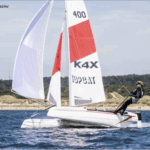
A few years back, there was a situation where a laser capsized immediately in front of the finish line, and current carried it across before the sailor righted it. There was some argument as to whether or not capsized was
in normal position
, but that discussion missed the point. Take a careful read of the definition of finish:
Note the position of the first comma.
crew
or
equipment
must be in normal position, but the
hull
can be in any position. Therefore the boat in question finished when her hull crossed the finishing line, regardless of being upright or capsized.
I hope that was interesting,
I'm not so sure that noting the position of a comma in a grammatically incorrect sentence is all that enlightening.
Actually, it's two commas (I misquoted the first time, sorry).
The position of the commas separates the clause
or crew or equipment in normal position
, meaning that
in normal position
does not apply to the
any part of her hull
clause. So, the hull may be in any position and still satisfy the definition of finish.
Regards,
Eric
This rule does not permit a capsized boat to receive righting assistance - only help for crew in danger.
I hope that helps,
Eric
Good rule. Common case, crew overboard, separated from boat, gets assistance to get back to boat.
I agree - common sense- return the separated crew and let them effect the righting and sailing with no penalty (they're probably going to be last anyway). Help with righting would DSQ
But were we originally talking about the youth sailing events? Should a youth team be allowed righting (or other) assistance with no penalty?
And I'm not talking about
youth
like Reiss or Casey. Those F*ers don't need no stinkin' assistance <img src="<>/smile.gif" alt="smile" title="smile" height="15" width="15" /> They can usually sail faster sideways than some of us can sail
regular
Don't you hate it when someone (usually a Yout) flips, rights it, and still beats you by a mile?
Mike
Yes, I do hate that, but it's not like they're going to take my Rum at the bar, so it kinda works out in the long run...
.....or when your idiot skipper flips, and then after righting the boat, sails the wrong way up the river. Don't ask me how I know.
Oh yeah, I forgot to add that to my
things that suck
list.
Thank goodness we didn't need the GPS...
And, after close inspection of the daggarboard with my face, there appeared no scuffs

My opinion would be that the righting assistance = dsq is not a penalty... it's a disqualification for a lack of seamanship. Regattas are won by the best most consistent sailor (they might never win a race!). This is the nature of the game and changing the outside assitance rule would be a fundamental change in the nature of the game.
The practical problem would be that coach and spectator boats would now be part of the racing game.... Now they are on call by the PRO for safety reasons.... With your white shark rule.... a teams personal guardian angel would shadow you up the course and then race to help you get back in the game when you screw up.
I distinguish a penalty from a dsq... A penalty is a circle on the water or a time hit on a distance race. A dsq is for events that would fundamentally change the game. (Like outside assitance)
YMMV
I agree with Mark on this. Flipping and subsequent righting are part of your racing (or lack there of)skills. If a
white shark
were truly involved the DSQ is the least of your worries.