

I thought the jib was only an advantage over a unirig when reaching and that up wind it didn't make much difference.
Going down wind with a spinnaker I'm not sure a self tacking jib makes much difference vs. a uni rig - as the sail area tends to be rather small compared to the main and spin. That said, they also look after themselves when gybing and tacking so I'd rather have one for the all round flexibility when distance racing.
Chris.

>>I thought the jib was only an advantage over a unirig when reaching and that up wind it didn't make much difference.
That dependent on how you define the comparison. And no this is no joke. There are three ways of looking at it :
-1- First is trivial, If both are sailing without a spi then the sloop is definately faster around the course.
-2- The unirig has the same overall sailarea as the main+jib combined of the sloop and both sailing with spis. With the right mast height (not too high) the uni will sail just as fast or slightly faster upwind than a sloop rig. While reaching the roles are reversed.
-3- The uni-rig has a the same sailarea as the mainsail of the sloop and both use spis. Here the sloop is faster upwind, faster on a reach and about as fast on downwind legs.
So the question is from what point are you looking at your boat ?
If you have a boat and want to go faster than removing the jib is not going to help you. That will only make you slower. If you boat is a uni-rig and you have righting moment left unused and want to go faster than putting a jib on is most efficient. At least more efficient than putting a larger mainsail on the same mast. If you are prepared to totally modify the rig than completely new mast and mainsail combo could make you faster around the course if you get the ratio's right. However the gains are dependent on windstrength and you could well find you gained in light air something that you are lacking as a result in heavy air.
No matter how you look at it, one can always put more sailarea on a boat when it is a sloop rig than you can on a uni-rig. On courses that do not require high pointing this means more speed. And on courses that do require high pointing this means that more speed compensates for lower sailed angles to some extend. It dependents on the ratios where the compensation is partially or more than enough to fully compensate.
>>Going down wind with a spinnaker I'm not sure a self tacking jib makes much difference vs. a uni rig - as the sail area tends to be rather small compared to the main and spin.
That seems to be the case.
>>That said, they also look after themselves when gybing and tacking so I'd rather have one for the all round flexibility when distance racing.
And that is where the sloop is best.
Wouter
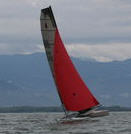
Hi Wouter
you said:
-1- First is trivial, If both are sailing without a spi then the sloop is definately faster around the course.
my opionin:
If this would be the case, all the A-Cats would carry a gib....
you said:
-2- The unirig has the same overall sailarea as the main+jib combined of the sloop and both sailing with spis. With the right mast height (not too high) the uni will sail just as fast or slightly faster upwind than a sloop rig. While reaching the roles are reversed.
my opinion is
When sailing under gennacker, the gib IMO dosn't do mutch.
I think the Uni will be faster, because with the higher mast, you can hoist a gennacker that has a better aspect ratio, there is a bit more wind high up and I think that the high aspect main will be more effectiv too.
![[Linked Image]](http://www.catsailor.com/bb_files/40089-KaeserAndiSpiRun.jpg)
>>Wouter said:
-1- First is trivial, If both are sailing without a spi then the sloop is definately faster around the course.
>>Andreas said in my opinion :
If this would be the case, all the A-Cats would carry a gib....
The only reason why A-cats don't use a jib is because they have a overall sailarea limit in their rules. Meaning that any sailarea that goes into the jib must come out of the mainsail. If the A-cat rules did not limit this then we would only see A-cats with jibs. Add to this that A-cats like to race on courses where there is an upwind finish and you can see how the rules openly favour optimizing the boat for upwind sailing and take what ever bad you have on the downwind.
So the fact that A-cats don't use jibs ONLY says that for a given overall sailarea and the perfered race course a uni-rig is more efficient.
The truth of the statement above doesn't help us much when looking at courses that are not favoured to the upwind leg and when looking at designing a catamaran from scratch where any amount of sailarea is allowed to be put on a boat.
Again a sloop rig boat can ALWAYS have more sailarea than a uni-rig for a given righting moment or mastweight or acceptable pitching moment etc.
Due to the misunderstanding of the A-cats, and a few forcefull effort to propel the myth, quite a few sailors now believe that area put in the mainsail is AERODYNAMICALLY more efficient than the same amount put in the jib. This can simply not be maintained as a truth. If anything one most specify who one defines the measure of efficiency. I will give a few examples as colloberated by wind tunnel tests and measurements at sailboats. Spi are not included in the following points.
-1- The combination of a jib and mainsail produces MORE saildrive than just the mainsail. The interaction between the sails is the cause of this. The net effect is smallest on the upwind leg and increases (sometime strongly) when the apparent move increasing away from the bow. On all boats this means more speed. On downwind legs this means more depth
-2- The combination of a jib and mainsail produces MORE saildrive than just a mainsail of the same overall size on the same mast. The interaction between the sails is the cause of this. The net effect are smallest than in point -1-
-3- The combination of a jib and mainsail OFTEN produces MORE saildrive than just the mainsail of the same overall size on a taller mast. The interaction between the sails is the cause of this. In most cases it does in some case it does not. Pretty much in very light winds the taller rig produces more drive while in medium to heavy winds the shorter rig produces more drive.
-4- The speed of a sloop rigged boat (not talking VMG here) is always higher than the same platform with a uni-rig.
-5- VMG of a uni-rig boat MAY be higher on a upwind leg when the ratio's are carefully optimized. If they are not than the gains can well be zero or negative. The VMG on the downwind leg however is ALWAYS favouring the sloop rigged boat except in extreme light wind condition (laminair winds) Pretty much anything over 5 knots will favour sloops.
By fitting a spinnaker the uni-rigs correct out over their disadvantages downwind. However simply having a uni-rig upwind is not enough to beat sloops on the upwind. A great example of this was giving by two Tornado sailors last year (Medwell (Aus) of Tornado Alive). They had to sail without a jib against a training buddy or something with a jib. The sloop rig WON upwind. The sloop boat stayed powered up in the lulls and had slightly more boatspeed. The difference was small but it was definately there and when seconds count (as in the tornado class) then you want to sail with a jib.
What can we take away from this latter example. That the additional pointing of removing the jib in is NOT enough to compensate for the loss of speed. For the techies among us this means that the reduction of saildrive as a result of having less sailarea and despite the increase in mainsail drive due to reduced capsize/righting moment, was such that there was a significant speed loss. Pointing 5 degrees higher (at least) and still have inferiour VMG means you must loose at least 8 % speed (cos(40) / cos(45)). That is ALOT !
Increasing the mainsail area may OR may not help you. It will definately NOT help you in double trapeze conditions. I may marginally help you in medium conditions and without increases in mast height will NOT help you in light winds.
Adding area to the leach of a mainsail is NOT very effective when compared to adding it to a jib that can make use of the slot effect that is also so important in C-class boats. The way the slot works is also widely misunderstood but that is a different topic.
So what am I arguing here. That one can never say that a uni-rig is better then a sloop. Because that would suggest that it is alwasy better and that is certainly not the case. Can we say that they uni is worse than the sloop. No, by the same reasoning this is equally untrue.
Than can we look at the A-cats and conclude that uni-rigs are more often superior to a sloop than not ? No we can not as the answer is fully dependent on additional limits you state regarding the specifications of the design. The same reasoning holds visa versa.
Than what can be say about the comparison between the uni and sloop. First that sloop has gotten a rep that is doesn't deserve. We can say that uni-rigs are cheaper to produce. We can say that distance races tend to favour sloops because they are often held in conditions and on courses that is detrimental to the uni-rigs advantages. Uni-rigs perform by being succesful at working a balance act that underlies upwind VMG's while sloops rely more on brute force and brute speed to obtain VMG's.
Lets get on to point 2.
>>Wouter said:
-2- The unirig has the same overall sailarea as the main+jib combined of the sloop and both sailing with spis. With the right mast height (not too high) the uni will sail just as fast or slightly faster upwind than a sloop rig. While reaching the roles are reversed.
>>>Andreas said my opinion is :
When sailing under gennacker, the gib IMO dosn't do mutch.
I think the Uni will be faster, because with the higher mast, you can hoist a gennacker that has a better aspect ratio, there is a bit more wind high up and I think that the high aspect main will be more effectiv too.
The opinion of Andreas does not go against what I said. As I only talked about the upwind and the reachign leg (No spi). I agree that under spinnaker the jib is not doing very much. However I don't think the uni-rig is arguably faster. The hoist height and aspect ratio of the spi are afterall not directly linked to being a uni-rig or not. Afterall the HT's didn't have a higher aspect ratio than the F18's in the past. This was a diect result of the fact that the HT's had limited the hoist height to the same level as the F18's. With regard to heavy more wind up high. While this is theoretically true in practice the wind speed difference experienced at the top of a 9 mtr mast and 10 mtr mast is about 1 % in all winds above 5 knots. The Turbulant character of the winds makes the speed dependency to follow a parabolic curve and not a linear line as is the case at liminair winds. Combine this with the fact there is relative little sailarea this high makes the total net effect rather small. That is even before noting that the mainsail may only provide a 25 % of the total saildrive while sailing with a spi.
So if we run a imaginairy number example.
say 5 % more windspeed up high (far to much) => Lets round up upward by not looking at sailarea in the top so 5% more saildrive in the mainsail => power mainsail + power spi = 25% * 105 % + 75 % = 101.25 % more drive => taking 2.5 order root => 100.49 % more speed on downwind leg. Or 3 seconds on a long 10 minute downwind leg. This is less than the disadvantage you experience by sailing 5 kg overweight.
As you can see. gains in mainsail drive under spinnaker are quickly reduced in overall importance, Difference may end up being miniscule even though differences may really exist.
And this bring me to a second point. The fact that one can proof a certain difference must exist does not mean that its net effect is anything noticeable.
Sure a taller mainsail experiences slighly more wind high up there but this doesn't mean that it will make the boat differ on the downwind leg in any significant way.
In the end it is all about ratios and weigthing factors. Not about which one is theoretically more efficient Aerodynamically than another and which one can point higher. It is about which one strikes the best balance between conflicting phenomena. And sadly the last is rather sensitive to class rules and selfimposed limits.
This is why we see A-cats without jibs reach the A-mark first only to see them loose the race against F18's and have a fools chance of winning a distance race. And this is also why the F18 in turn has a serious weakspot to any 18 foot sloop rigged boat that weights in at 150 kg or less. And we can continue like that.
As a last point I would like to add that we really must pass the point of "I believe, I think, Could it be"; there is more than enough data available now to support all the points made above.
If anybody want to do some testing themselfs. Than I advice you to do the following :
Get another crew of equal skill, get two sloop rigged boat and race them against eachother while :
-1- Remove the spi from both boats and the jib of one sail a triangular course. Note the boat who wins most often.
-2- Remove the spi from both boats and the jib of one sail a windward leeward course. Note the boat who wins most often.
-3- Remove the spi from both boats and the jib of one sail a windward-leeward course with an upwind finish. Note the boat who wins most often.
-4- With spi but remove the jib of one boat and run the points 1 to 2 over again. Note the boat who wins most often.
I dare wager that the winner in all comparisons is one and the same boat although the margins of victory may be significantly reduced.
Which comparisons are left.
Jibless boat get larger mainsail and jibless boat get larger mainsail on larger mast.
This is a little more difficult if not expensive to test but we can already say that 4 out of 6 possible comparisons favour one particular setup over the other. There is only 2/6 = 1/3 of the comparisons left to favour the other one.
This should be enough to see that the situation is not as clear cut as the statement ;"If this would be the case, all the A-Cats would carry a gib.... "
That is all
Wouter
Hi Wouter
Allot of text 😉
as you said:
-1- First is trivial, If both are sailing without a spi then the sloop is definately faster around the course.
i was thinking that you were talking of a restricted sail area, the same area for the uni and the sloop.
Now if we increase the sail area for a sloop, to the max a plattform can carry for a given windspeed, i agree that the sloop (with the same sail area) will be faster and the uni is in trouble, but as soon that there is less wind, this advantage will be lost to the uni and the uni is faster.
greetings from cold switzerland!
Plus uni's are cooler looking....
Nice looking boat Andreas! Do you prefer sitting cross leg facing forward while driving downwind? Are you doing that so you dont get in the way of your crew? How do you keep from sliding down the tramp? Dont you find it more comfortable to sit on the hull?
Bill
Hi Bill
Do you prefer sitting cross leg facing forward while driving downwind?
no not actually 😉
In this picture we were just sailing towards the spectators boat (thats were the picture was made from) and had allot of boats around us. so i guess the reason for the unusual position was to have a better view at the other boats around us.
Normally I sit on the hull, in rough conditions one leg goes to the daggerboard, to prevent forward motion and i hold my self with my outer hand on the beam.

You seem to be overlooking one small fact Wouter when comparing uni with sloop (same boats) and that is that most (not all of course) cats when sailing sloop rigged sail with two people on board but usually only with one person on board when uni, this weight difference obviously will have a strong bearing on the comparitive performances.
The most obvious example of this in Australia where the uni/sloop contest has been in hot competition for over 30 years between the sloop and the cat rigged mosquitoes. The results have varied over the years when for some time the uni's have been superiour and for other years the sloop have had the ascendency. About the only real conclusion that could be drawn over such a long period of time is that the only real difference has been the quality of the sailing skills of the people in the relative classes at the time and that in either form the boats were too close in performance to be able to make any truely OBJECTIVE conclusion.
I didn't overlook that. I just find it self evident that the comparisons are made between boats that are the same in every respect except in the differences that were stated. There is never any point in comparing apples with oranges.
All I said holds true when comparing doublehanders with eachother or singlehanders with eachother. As long as you don't compare doublehanders with singlehanders and visa versa.
Wouter